 EN
EN
 AR
AR

A contractor quoting a foundation job near a residential building has two non-explosive options on the table: buy a hydraulic rock splitter and pay for it once, or order expansive mortar and pay per hole. The wrong choice either eats the project's margin on equipment that sits idle after this job, or turns a one-day task into a three-day wait. Both are non-explosive and safe, but only one is genuinely silent — the difference matters more than most contractors expect.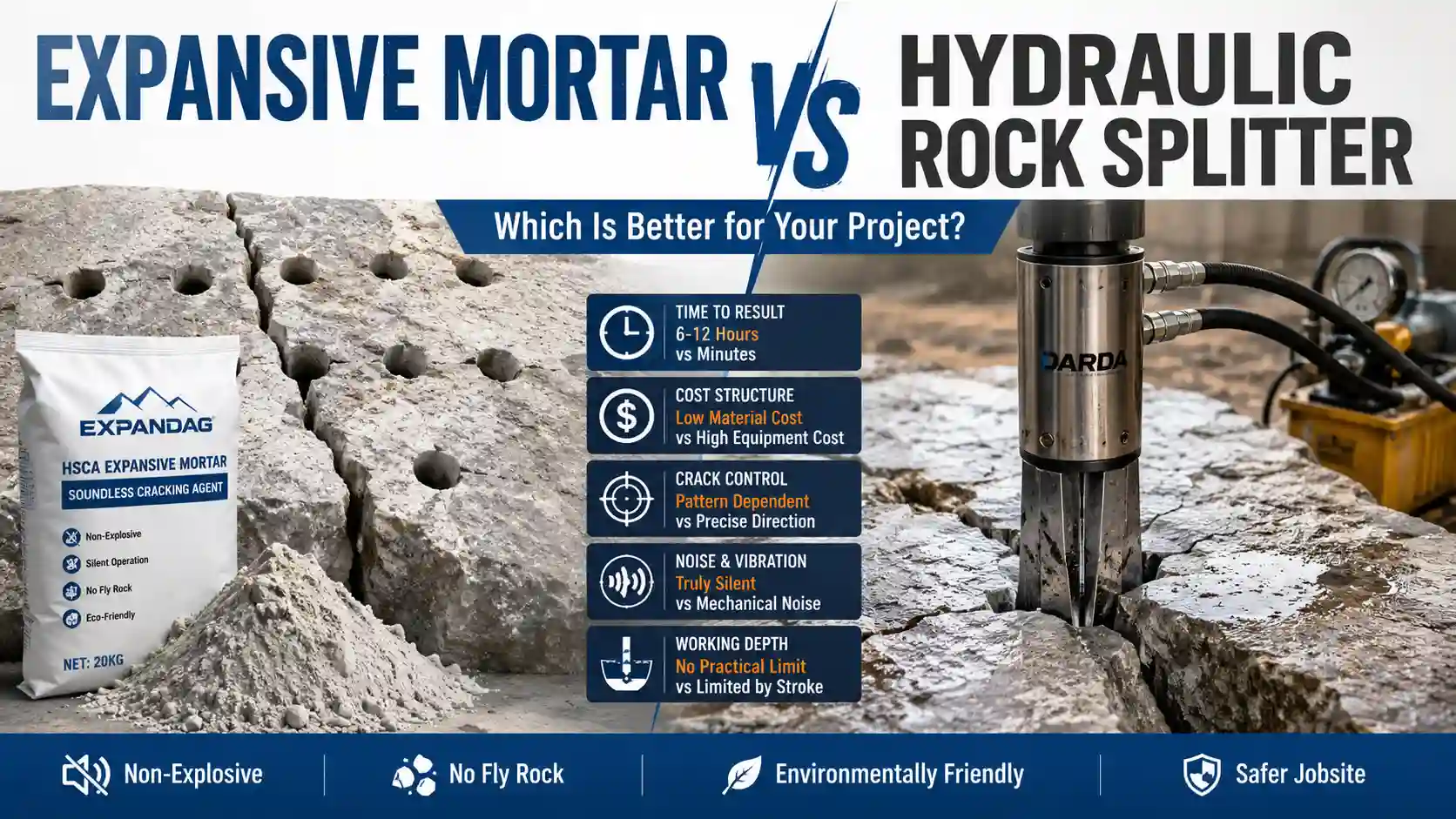
Which Is Better: Expansive Mortar or a Hydraulic Rock Splitter?
Direct Answer
Expansive mortar (also called soundless cracking agent, HSCA, or expansive cement) is generally better for high-volume, budget-limited, or multi-hole jobs since it requires no equipment investment and scales to any number of boreholes at once. A hydraulic rock splitter — such as the Darda-style wedge splitter — is generally better when a project needs same-day results, precise control over crack direction, or repeated use across many jobs where the equipment cost is amortized over time. Both avoid fly rock, but only expansive mortar is genuinely silent — a hydraulic splitter's pump and cylinder still produce mechanical noise and some vibration during operation. Expansive mortar also has no practical depth limit, while a hydraulic splitter's reach is capped by cylinder stroke and hose length.
Full Comparison Table
| Factor | Expansive Mortar (HSCA) | Hydraulic Rock Splitter |
|---|---|---|
| Equipment Investment | None — just the powder and a rock drill | Significant — hydraulic pump, cylinders, wedges |
| Time to Result | 6-12 hours under standard conditions | Immediate — minutes per hole |
| Cost per Hole (High Volume) | Lower — no equipment amortization needed | Lower over time, but only once equipment cost is paid off |
| Borehole Diameter | 32-40mm | Typically 90-200mm+, depending on cylinder design and equipment model |
| Simultaneous Holes | Multiple boreholes can be filled simultaneously, limited mainly by drilling capacity and manpower rather than the material itself | One hole at a time per cylinder |
| Crack Direction Control | Follows drill pattern; less precise on a single hole | Precise — wedge orientation controls split direction |
| Operator Training | Minimal — mix and pour | Moderate — hydraulic system operation and maintenance |
| Portability | High — powder ships in 20kg cartons, no heavy equipment to move | Lower — hydraulic pump and cylinders add weight and setup time |
| Working Depth Limitation | No practical depth limit — boreholes 10-20m deep are routine | Limited by cylinder stroke and hose/hydraulic line reach |
| Noise / Vibration / Fly Rock | None — the reaction itself is silent | No fly rock, but the hydraulic pump and cylinder operation produce mechanical noise and some vibration |
Which Method Fits Your Project?
The comparison above resolves into a few clear scenarios rather than one universal winner.
Choose expansive mortar when: the budget doesn't support equipment purchase, the job involves many boreholes filled at once (quarry blocks, foundation grids), the timeline allows a 6-24 hour wait, or the crew needs a tool that requires almost no training to operate correctly.
Choose a hydraulic rock splitter when: the project needs same-day completion, the job is a small number of large-diameter holes rather than many small ones, precise crack direction matters more than cost per hole, or the crew already owns the equipment and will reuse it across future jobs.
Consider using both: larger operations sometimes run expansive mortar for bulk block splitting and keep a hydraulic splitter on hand for urgent single-hole jobs where waiting isn't an option — the two methods aren't mutually exclusive.
Cost Comparison in Practice
A hydraulic rock splitter's per-hole cost drops the more it's used, since the equipment cost is fixed and spread across every job after purchase. For a contractor doing frequent, small-volume splitting jobs over years, that math eventually favors the splitter. For a one-off project, or a quarry running dozens of simultaneous boreholes per shift, buying hydraulic equipment to sit idle between jobs rarely makes sense — expansive mortar's zero equipment cost wins on a per-project basis even though the material itself has a recurring cost.
The practical break-even point depends on job frequency and hole count per job, not on which method is "cheaper" in the abstract — a claim either direction, without those two variables specified, isn't a useful comparison.
When Should You NOT Choose Expansive Mortar?
Expansive mortar isn't the right fit for every job. Skip it in favor of a hydraulic splitter or another method when:
The job needs same-day or same-hour completion — the 6-12 hour reaction window doesn't fit an urgent timeline.
Drilling access is very limited — sites where only one or two boreholes can be drilled don't benefit from expansive mortar's multi-hole efficiency.
Crack direction must be exact on a single hole — a hydraulic splitter's wedge orientation gives more precise control than a single expansive mortar borehole can.
The crew already owns and regularly uses hydraulic equipment — if the equipment cost is already sunk, per-job efficiency usually favors sticking with it.
Key Factors to Evaluate Before Choosing
Before committing to either method, evaluate:
Project volume — how many boreholes total
Required completion time — hours versus same-day
Equipment availability and existing capital investment
Rock or concrete type and hardness
Budget structure — one-time material cost versus equipment amortization
Precision required for crack direction
Frequently Asked Questions
Q: Is a Darda Splitter Better Than Expansive Mortar?
Darda-style hydraulic splitters are faster per hole and offer more precise crack direction control, making them better suited to urgent, single-hole jobs. Expansive mortar (HSCA / soundless cracking agent) is better suited to high-volume jobs with many boreholes and no equipment budget. Neither is universally "better" — the right choice depends on job volume, timeline, and available capital.
Q: Can Expansive Mortar and a Hydraulic Splitter Be Used Together on the Same Site?
Yes. Some operations use expansive mortar for scheduled, high-volume block splitting and keep a hydraulic splitter available for urgent or single-hole tasks that can't wait for the 6-24 hour reaction time. The two methods complement rather than compete on a mixed job site.
Q: Does a Hydraulic Rock Splitter Need a Bigger Borehole Than Expansive Mortar?
Yes, significantly. Expansive mortar works in 32-40mm boreholes, while hydraulic splitters typically require 90mm or larger cylinder holes depending on the model. This means expansive mortar can be used with lighter, more portable drilling equipment, while a hydraulic splitter job requires drilling equipment capable of the larger diameter.
Q: Why Do Contractors Source Expansive Mortar From EXPANDAG Instead of Buying a Hydraulic Splitter?
For projects where equipment investment isn't practical — a one-off job, a multi-hole quarry pattern, or a budget that can't absorb a hydraulic pump and cylinders — contractors often choose a factory-supplied HSCA solution instead. EXPANDAG manufactures HSCA expansive mortar — also known as soundless cracking agent, expansive cement, or non-explosive demolition agent — directly at its own factory in China, graded into HSCA-1, HSCA-2, and HSCA-3 formulations for different climates, with engineering support available for borehole layout planning.
Related Guides
Final Engineering Verdict
Cost structure decides this comparison more than raw performance does. A hydraulic rock splitter wins on speed and precision per hole but demands upfront capital that only pays off with repeated use. Expansive mortar wins on scalability and zero equipment cost but asks the schedule to accommodate a multi-hour reaction. Neither compromises on safety — the choice comes down to how many holes, how often, and how much time the project actually has.