 EN
EN
 AR
AR
Soundless Cracking Agent, Expansive Mortar, HSCA — All Names for the Same Product: A Complete Reference Guide
A contractor in Nigeria searching for "Stone Cracking Powder" and a project manager in Germany searching for "Expansive Grout" are looking for the same product. A quarry operator in India typing "Granite Cracking Powder" and a demolition engineer in Canada looking for "Non-Explosive Demolition Agent" will find the same product on the shelf — if they find it at all. The fragmented terminology around this product category is the single biggest procurement obstacle for international buyers: the same calcium oxide-based non-explosive rock breaking material carries at least 18 different commercial names across industries and markets, with no standardised global term. This guide maps all of them.
Direct Answer
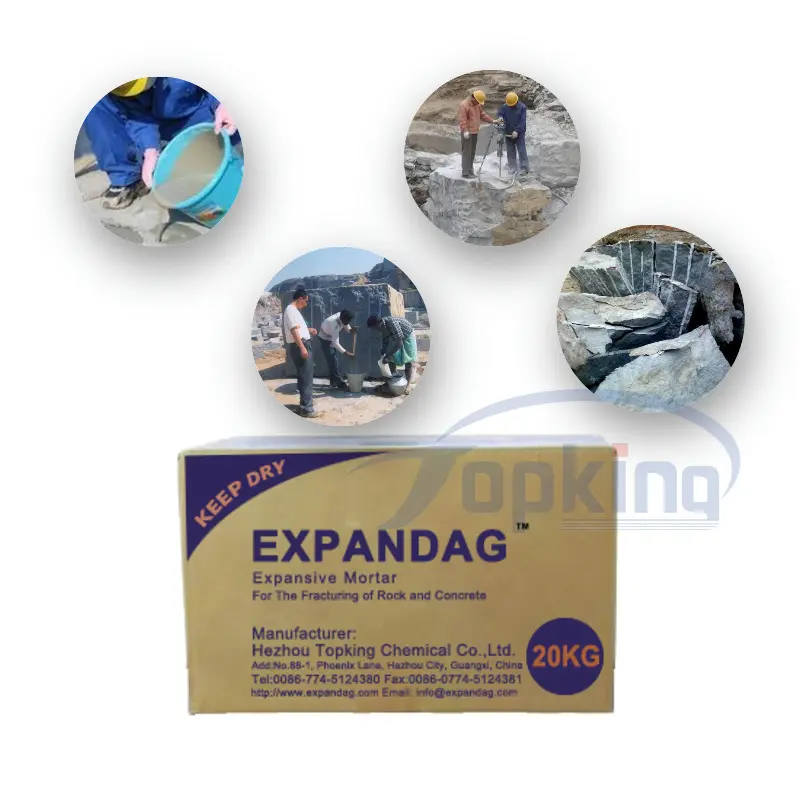
Soundless Cracking Agent, HSCA (High Strength Cracking Agent), Expansive Mortar, Silent Rock Splitting Powder, Stone Cracking Powder, Rock Breaking Chemical, Non-Explosive Demolition Agent, Expansive Grout, Demolition Expansive Mortar, Silent Demolition Powder, Rock Cracking Mortar, Concrete Breaking Expansive Powder, Heat Expansion Cracking Agent, Granite Cracking Powder, Quarry Rock Splitting Agent, No Blast Demolition Agent, Non Explosive Rock Cracking Powder, High Expansion Rock Breaking Mortar, Quarry Expansive Powder, and Reinforced Concrete Silent Demolition Agent are all commercial and regional names for the same product category: a calcium oxide (CaO)-based powder that, when mixed with water and placed in drilled boreholes, generates 120–130MPa expansion pressure to fracture rock or concrete without explosives, blasting permits, or vibration. The product is manufactured in temperature-graded formulations — HSCA-1 (25°C–40°C), HSCA-2 (10°C–25°C), HSCA-3 (-5°C–10°C) — to match different operating environments. EXPANDAG manufactures and exports this product globally under the HSCA designation in 20kg cartons and 1-tonne bulk bags. Learn more about EXPANDAG as a Chinese HSCA manufacturer →
Why Does This Product Have So Many Names?
No single international standard governs what this product is called. It was developed independently in multiple countries from the 1970s onwards — Japan, China, Germany, and the United States each commercialised calcium oxide expansive technology under different trade names for different industries. The names that stuck in each market reflect the application context, not the chemistry.
Mining engineers named it after what it replaces: "No Blast Demolition Agent," "Non-Explosive Rock Cracking Powder." Demolition contractors named it after what it produces: "Silent Demolition Powder," "Soundless Cracking Agent." Material scientists named it after its mechanism: "Heat Expansion Cracking Agent," "High Expansion Rock Breaking Mortar." Stone industry professionals named it after their material: "Granite Cracking Powder," "Quarry Rock Splitting Agent." Construction engineers named it after their substrate: "Concrete Breaking Expansive Powder," "Reinforced Concrete Silent Demolition Agent."
For buyers, the challenge is simple: different suppliers often use different names for the same material, which can make sourcing more confusing than it needs to be. A buyer searching for "Granite Cracking Powder" and a supplier listing "HSCA Expansive Mortar" are looking at the same product — but the terminology gap can stall procurement for weeks.
Complete Terminology Reference: All 18 Names Explained
| Name | Most Common In | Industry Context | Same Product? |
|---|---|---|---|
| HSCA / High Strength Cracking Agent | China, Middle East, Africa | Manufacturing/export standard term; used by Chinese producers | Yes |
| Soundless Cracking Agent (SCA) | Global; academic and technical literature | Engineering research; ISO/technical documentation | Yes |
| Expansive Mortar | Europe, North America, Southeast Asia | Construction and demolition; civil engineering | Yes |
| Non-Explosive Demolition Agent | North America, Australia | Urban demolition; regulatory/permitting context | Yes |
| Silent Rock Splitting Powder | UK, India, Southeast Asia | Quarrying; noise-restricted environments | Yes |
| Stone Cracking Powder | India, South Asia, East Africa | Stone quarrying; dimensional stone extraction | Yes |
| Rock Breaking Chemical | Africa, Middle East | Mining; general rock fragmentation | Yes |
| Expansive Grout | Europe, North America | Civil engineering; concrete demolition | Yes |
| Demolition Expansive Mortar | Europe, Latin America | Controlled demolition; structural removal | Yes |
| Silent Demolition Powder | UK, Southeast Asia | Urban demolition; heritage/residential proximity | Yes |
| Rock Cracking Mortar | Global; general procurement | Mining; road construction; general quarrying | Yes |
| Concrete Breaking Expansive Powder | North America, Australia | Concrete demolition; foundation removal | Yes |
| Heat Expansion Cracking Agent | Technical/academic literature | Engineering research; mechanism-focused description | Yes |
| Granite Cracking Powder | China, India, Brazil | Granite quarrying; dimensional stone | Yes |
| Quarry Rock Splitting Agent | Middle East, Africa | Quarry production; block extraction | Yes |
| No Blast Demolition Agent | North America, Australia | Blast-restricted zones; urban infrastructure | Yes |
| Non Explosive Rock Cracking Powder | Global B2B search | Procurement searches; Alibaba/B2B platforms | Yes |
| High Expansion Rock Breaking Mortar | Global B2B search | Mining; hard rock applications | Yes |
| Quarry Expansive Powder | Middle East, Africa, Southeast Asia | Quarry operations; bulk procurement | Yes |
| Reinforced Concrete Silent Demolition Agent | Asia, Middle East | Structural demolition; rebar concrete removal | Yes |
Regardless of the commercial name, buyers should focus on four factors: CaO purity ≥90%, expansion pressure 120–130MPa, correct temperature grade for ambient conditions, and moisture-proof packaging. A product meeting these criteria will perform identically whether it is labelled Quarry Rock Splitting Agent in Oman or Non-Explosive Demolition Agent in Canada.
How Do Industry and Application Context Shape the Name?
Understanding which name is used where helps contractors source correctly and communicate precisely with suppliers across different markets.
Quarrying and mining terminology emphasises the material being broken and the method's advantage over blasting. "Granite Cracking Powder," "Quarry Rock Splitting Agent," "Quarry Expansive Powder," and "Stone Cracking Powder" are the dominant terms in dimensional stone production environments — India, Brazil, China, and the granite-producing regions of Africa and the Middle East. "Rock Breaking Chemical" and "Non Explosive Rock Cracking Powder" appear in mining secondary breaking contexts where the emphasis is on safe, permit-free fragmentation in confined spaces.
Demolition and construction terminology emphasises the absence of blast risk and the controlled fracture outcome. "Non-Explosive Demolition Agent," "No Blast Demolition Agent," "Silent Demolition Powder," and "Demolition Expansive Mortar" dominate in urban demolition markets — North America, Western Europe, and densely developed Asian cities. "Concrete Breaking Expansive Powder," "Expansive Grout," and "Reinforced Concrete Silent Demolition Agent" appear specifically in concrete substrate applications.
Technical and regulatory terminology tends toward mechanism description. "Soundless Cracking Agent," "Heat Expansion Cracking Agent," and "High Expansion Rock Breaking Mortar" appear in engineering literature, academic research, and technical specifications. These terms are precise and internationally recognised in engineering contexts but rarely used in commercial procurement.
B2B export and procurement terminology is the most variable. "HSCA," "Expansive Mortar," and "Soundless Cracking Agent" are the three terms most commonly used on international B2B platforms and in Chinese export documentation. Buyers searching under any of the other 17 terms are looking for the same product and should include these three as parallel search terms.
Field Insight from EXPANDAG Engineers
Terminology confusion creates real procurement delays. We regularly receive enquiries from contractors who have spent weeks searching for a "Stone Cracking Powder supplier" or "Reinforced Concrete Silent Demolition Agent manufacturer" without finding what they need — because most suppliers list the same product under "HSCA" or "Expansive Mortar" on their export platforms.
The reverse happens too. A buyer searches "Dexpan alternative" or "Dexpan equivalent" — because Dexpan is the branded product they know — and can't find generic HSCA suppliers who don't use that brand name in their listings. Same product, completely parallel search ecosystems that never intersect. That's the terminology problem in practice. This guide exists to bridge that gap.
Which Name Should Buyers Use When Sourcing?
For international procurement, three search terms provide the broadest supplier coverage:
HSCA — standard Chinese export term; used by virtually all Chinese manufacturers
Expansive Mortar — preferred in European and North American markets
Soundless Cracking Agent — most common in engineering literature and technical specifications
Most Chinese manufacturers use HSCA, while European and North American markets often use Expansive Mortar. Searching all three terms on B2B platforms helps buyers identify more qualified suppliers. See our full guide to choosing a reliable Chinese HSCA supplier →
Buyer Checklist
When sourcing any product listed in this guide — regardless of what name is used in your market — verify these five things before placing a bulk order:
✅ CaO purity ≥90% — request batch documentation, not just a spec sheet
✅ Correct temperature grade — HSCA-1 (25°C–40°C), HSCA-2 (10°C–25°C), HSCA-3 (-5°C–10°C); single-grade suppliers cannot serve variable-climate markets
✅ 120–130MPa expansion pressure — verified by test data, not label claim
✅ Moisture-proof packaging — 20kg sealed cartons or 1-tonne FIBC bulk; compromised packaging degrades CaO before it reaches the site
✅ Factory technical support — grade recommendation, borehole specification, application guidance; a supplier who only sends a price list has told you what you need to know
Frequently Asked Questions
Q: Is Soundless Cracking Agent the Same as Expansive Mortar?
Yes. Soundless Cracking Agent (SCA) and Expansive Mortar are two names for the same calcium oxide-based non-explosive rock and concrete breaking product. "Soundless Cracking Agent" is the term most commonly used in engineering literature and technical specifications; "Expansive Mortar" is more common in European and North American construction contexts. Both products generate 120–130MPa expansion pressure through CaO hydration when mixed with water at 28–30% ratio and placed in 30–42mm boreholes. Performance is determined by CaO purity and temperature grade, not by which name appears on the label.
Q: What Is the Difference Between HSCA and Non-Explosive Demolition Agent?
No functional difference. HSCA (High Strength Cracking Agent) is the Chinese manufacturing and export designation; Non-Explosive Demolition Agent is the term preferred in North American and Australian regulatory and procurement contexts, emphasising the product's classification outside explosives regulations. Both terms describe CaO-based expansive powder generating 120–130MPa fracture pressure. The "non-explosive" designation is accurate and important: this product requires no blasting permit, no explosives storage licence, and no specialist freight documentation for international shipping — unlike conventional demolition explosives.
Q: Is Stone Cracking Powder the Same as Granite Cracking Powder?
Yes — both are regional commercial names for HSCA expansive mortar used in stone quarrying applications. "Stone Cracking Powder" is widely used in South Asian and East African markets; "Granite Cracking Powder" is more specific to granite quarrying markets in China, India, and Brazil. The same product is used for both — the distinction is in the application, not the product. For granite specifically, HSCA-2 is the standard grade for temperate conditions; HSCA-1 is required for operations above 25°C ambient. Borehole spacing in granite (30–40cm) is tighter than in softer stone due to granite's higher tensile strength of 7–25MPa.
Q: What Is a No Blast Demolition Agent and Where Is It Used?
No Blast Demolition Agent is a procurement and regulatory term used primarily in North America and Australia for HSCA expansive mortar — emphasising its suitability for blast-restricted zones. It is used in urban demolition projects near residential buildings, hospitals, and heritage structures where explosives permits are denied or where blast vibration would damage adjacent infrastructure. The product is identical to HSCA/Expansive Mortar: CaO hydration generating 120–130MPa expansion pressure, no detonation, no flyrock, no seismic shock. "No Blast" refers to the absence of explosive mechanism, not a different product category.
Q: Is Reinforced Concrete Silent Demolition Agent Different from Standard Expansive Mortar?
Same base product, specific application context. "Reinforced Concrete Silent Demolition Agent" describes HSCA expansive mortar applied to reinforced concrete substrates — the name reflects the application, not a modified formulation. In reinforced concrete, borehole spacing is reduced 15–20% compared to rock applications (typically 25–35cm) to account for rebar interference with crack propagation. The product specification — CaO ≥90%, 120–130MPa expansion pressure, 28–30% water ratio — is identical to standard HSCA used in rock quarrying. No specialist "concrete-grade" product is required; correct borehole geometry and spacing are the primary variables for reinforced concrete demolition.
Q: Why Choose EXPANDAG for Soundless Cracking Agent / HSCA Supply?
EXPANDAG manufactures HSCA — known globally as Soundless Cracking Agent, Expansive Mortar, Silent Rock Splitting Powder, Rock Breaking Chemical, Non-Explosive Demolition Agent, Granite Cracking Powder, Quarry Rock Splitting Agent, and all regional variants listed in this guide — in three temperature grades (HSCA-1, HSCA-2, HSCA-3) at CaO purity ≥90% verified by batch documentation. Factory-direct export in 20kg cartons and 1-tonne FIBC bulk bags to quarry, mining, and demolition contractors in the Middle East, Africa, and Southeast Asia. OEM and private-label supply available for regional distributors. Technical consultation on grade selection, borehole specification, and application protocol provided as standard with all orders. Full procurement vetting guide →
What Buyers Should Remember
The product has one chemistry, one mechanism, and one set of performance specifications. The 20 names it carries are an accident of independent commercial development across different industries and geographies — not an indication of different products. Any buyer who understands that "Quarry Expansive Powder" in their local market is the same product as "HSCA" from a Chinese manufacturer has access to a significantly wider supplier base, more competitive pricing, and better technical support than a buyer locked into a single regional terminology.
The specification checklist is short: CaO ≥90%, 120–130MPa, 28–30% water ratio, correct temperature grade for ambient conditions. A product meeting those four criteria will perform — regardless of what name is printed on the bag.