 EN
EN
 AR
AR
Dexpan vs Expansive Mortar (HSCA): Technical Differences, Performance, and Cost Analysis
Dexpan is a branded calcium oxide-based expansive demolition agent, while expansive mortar (HSCA, Soundless Cracking Agent) refers to the broader product category. Both work through the same hydration reaction of CaO, generating controlled expansion pressure inside drilled holes to fracture rock or concrete without explosives. In real quarry and construction applications, performance is generally comparable when correct temperature grades, borehole spacing, and water ratios are applied. The main difference is cost and supply chain structure rather than chemistry.
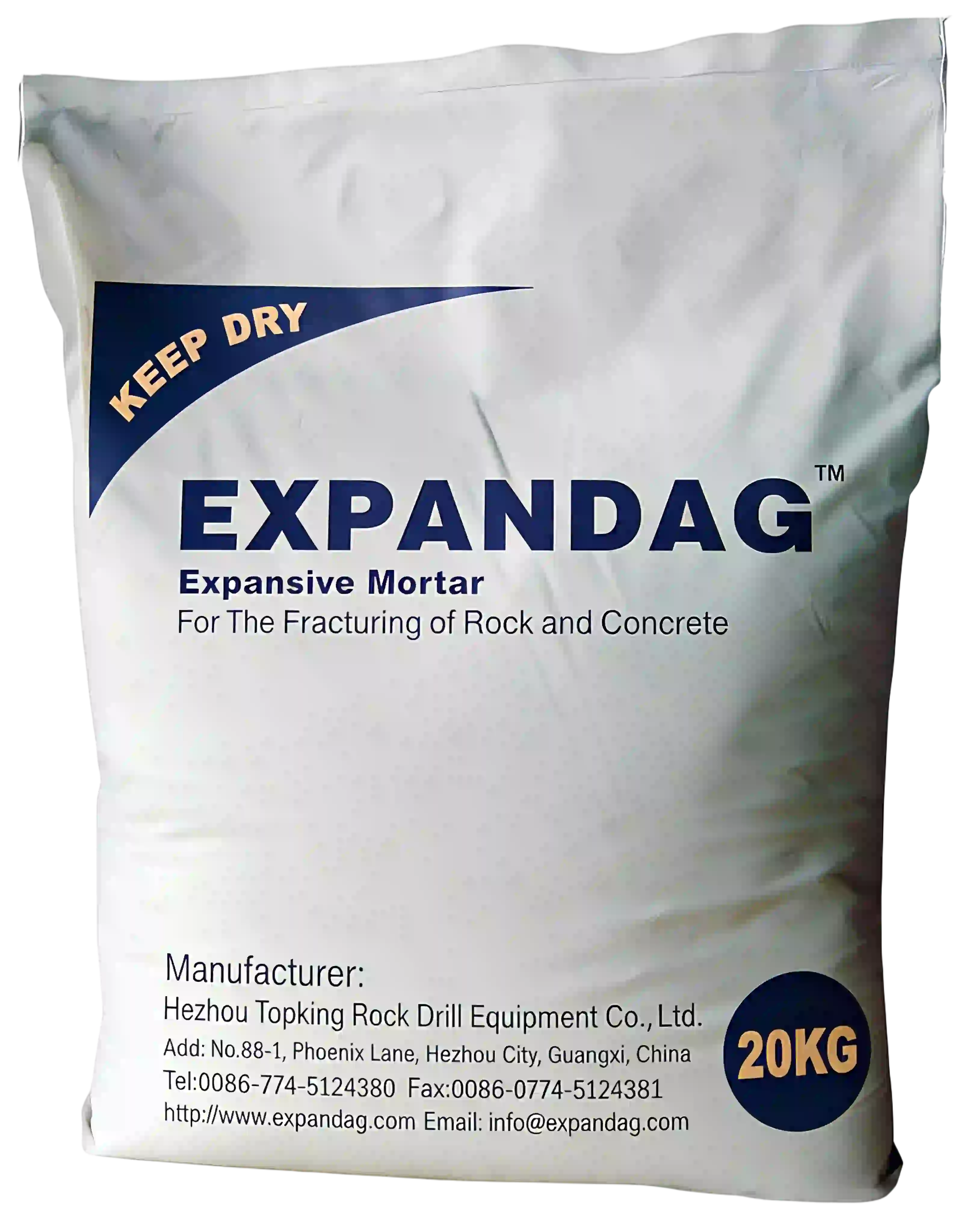
EXPANDAG System Note: EXPANDAG provides both pneumatic rock drilling equipment and HSCA expansive mortar as an integrated rock breaking system, enabling consistent compatibility from drilling to final rock splitting. Combined supply also helps reduce procurement complexity and logistics costs for quarry and mining operations.
1. What Is Dexpan and What Is Expansive Mortar?
Dexpan is a trademarked product within the expansive mortar category. Expansive mortar, also known as HSCA (High Strength Cracking Agent) or soundless cracking agent, is the general product class used for non-explosive rock and concrete demolition.
Both Dexpan and HSCA are based on calcium oxide (CaO) hydration. When mixed with water, CaO expands and creates internal pressure inside boreholes, exceeding the tensile strength of rock or concrete and producing controlled cracking without blasting.
2. Technical Performance Comparison
| Parameter | Dexpan | HSCA Expansive Mortar |
|---|---|---|
| Active Chemistry | Calcium Oxide (CaO) | Calcium Oxide (CaO) |
| Expansion Pressure | ~120 MPa | 120–130 MPa |
| Water Ratio | 28–32% | 28–30% |
| Working Temperature | 10°C–35°C | 10°C–40°C (graded types available) |
| Crack Formation Time | 4–24 hours | 4–12 hours |
| Cost Advantage | Premium brand pricing | 30–60% lower cost vs Dexpan |
3. Are Dexpan and HSCA Chemically the Same?
Yes. Both rely on the same calcium oxide hydration reaction. The expansion occurs when CaO reacts with water, producing calcium hydroxide and volumetric expansion pressure.
In real field applications, performance differences are primarily influenced by:
Accuracy of water mixing ratio
Borehole diameter, depth, and spacing design
Ambient temperature and seasonal conditions
Operator handling and filling procedure
4. Field Application Insight (Industry Observation)
Across quarry and mining operations, differences between branded and generic HSCA products are typically linked to application control rather than material chemistry.
Field reports from Middle East and African quarry projects show that incorrect temperature grade selection is the most common cause of inconsistent performance, especially in high-temperature environments where reaction speed increases significantly.
5. EXPANDAG Integrated Rock Breaking System
EXPANDAG delivers a combined solution consisting of pneumatic rock drills and HSCA expansive mortar, designed to ensure full compatibility across the drilling and rock splitting workflow.
Pneumatic rock drilling equipment
HSCA expansive mortar (Type 1 / Type 2 / Type 3)
This integrated approach improves operational consistency and reduces total procurement and shipping costs for large-scale quarry and mining projects.
6. Common Failure Modes in Field Applications
| Issue | Cause | Corrective Action |
|---|---|---|
| Premature blowout | Incorrect temperature grade selection | Use appropriate seasonal grade (especially in hot climates) |
| No or delayed cracking | Low temperature or excessive water ratio | Adjust water ratio and use winter-grade product |
| Weak fracture propagation | Improper borehole spacing or depth | Optimize drilling pattern design |
| Inconsistent performance | Non-uniform mixing or poor slurry control | Standardize mixing and filling procedure |
7. Is Expansive Mortar a Cost-Effective Alternative to Dexpan?
Yes. Properly manufactured HSCA expansive mortar is widely used as a direct functional alternative to Dexpan in quarrying, mining, and concrete demolition applications worldwide.
The primary advantage is economic efficiency. Generic HSCA products typically offer 30–60% lower unit cost compared to branded Dexpan while maintaining equivalent expansion pressure and field performance when correctly applied.
8. Quick Technical Summary
Both Dexpan and HSCA use CaO hydration chemistry
Expansion pressure: 120–130 MPa range
No blasting permit required (non-explosive method)
Performance depends more on application than brand
Temperature grade selection is critical for success
Cost difference: HSCA typically 30–60% lower
9. Frequently Asked Questions
What is the main difference between Dexpan and expansive mortar?
Dexpan is a branded product, while expansive mortar (HSCA) is the broader category. Both use the same chemical mechanism to generate expansion pressure for rock and concrete demolition.
Can HSCA replace Dexpan in quarry applications?
Yes. When correctly graded and applied, HSCA performs similarly to Dexpan in most quarry and mining conditions. The key factor is temperature matching and proper drilling design rather than product brand.
Why is HSCA more cost-effective than Dexpan?
HSCA products are typically produced without brand premium and distributed through more direct supply chains, resulting in 30–60% lower cost while maintaining equivalent chemical performance.
10. Final Engineering Conclusion
Dexpan and HSCA expansive mortar are functionally equivalent in terms of chemical mechanism and rock splitting performance. In practical applications, procurement cost, temperature grade selection, and application quality are the primary factors affecting project success.
EXPANDAG recommends selecting HSCA grade based on ambient temperature and project conditions to achieve optimal performance and cost efficiency.