 EN
EN
 AR
AR

How Long Does Expansive Mortar Take to Crack Rock?
A quarry crew in Oman filled 40 boreholes with EXPANDAG HSCA-2 at 07:00 AM and came back at 11:00 AM expecting to see cracks. Nothing visible. By 14:00, clear fracture lines had appeared across the bench. By 18:00, the blocks were ready for extraction. Right product, right protocol — they just didn't know the timeline to expect.
Direct Answer
Expansive mortar (soundless cracking agent) typically initiates visible cracks in rock within 4–6 hours at standard conditions of 10°C–25°C ambient temperature. At higher temperatures (25°C–40°C), crack initiation accelerates to 2–4 hours. In cold conditions (-5°C to 10°C), the reaction slows to 12–24 hours. Full crack propagation and block separation usually completes within 24 hours across all conditions. EXPANDAG engineers grade HSCA into three temperature-matched formulations — HSCA-1, HSCA-2, HSCA-3 — specifically so contractors don't have to guess. These timelines assume correct grade selection, 28–30% water ratio by mass, and 30–42mm borehole diameter. Expansion pressure of approximately 120–130 MPa under proper application conditions builds progressively — visible surface cracks typically appear after 60–70% of maximum pressure has developed, not at the moment filling completes.
Key Takeaways
Most expansive mortar begins cracking within 4–6 hours under normal temperatures.
Ambient temperature has a greater impact on crack timing than rock type.
Choosing the correct temperature grade is more important than adding extra water.
Most delayed cracking problems are caused by incorrect grade selection or borehole spacing.
How Does Temperature Change Crack Initiation Time?
Ambient temperature is the single variable that determines which HSCA grade to load on the truck. Get the grade wrong and the timeline below doesn't apply.
| Ambient Temperature | Correct Grade | First Visible Cracks | Full Separation |
|---|---|---|---|
| -5°C to 10°C (cold) | HSCA-3 | 12–24 hours | 24–48 hours |
| 10°C to 25°C (standard) | HSCA-2 | 4–6 hours | 12–24 hours |
| 25°C to 40°C (hot) | HSCA-1 | 2–4 hours | 6–12 hours |
| Above 40°C (extreme heat) | HSCA-1 + strict protocol | 1.5–3 hours | 4–8 hours |
The crack you see at the surface isn't when the reaction started — it's when pressure has built enough to overcome the rock's tensile resistance. The expansion was working long before that first line appeared. Crews often miss this.
Does Rock Type Affect Crack Timing?
Yes — but not the way most people expect. The expansion pressure timeline is identical regardless of rock type. What changes is when visible surface cracks appear.
Granite has tensile strength of 7–25MPa. The crack front needs to build enough pressure to propagate through that resistance before anything shows at the surface. Limestone at 2–10MPa shows visible cracks sooner because less pressure is required to initiate propagation. HSCA is doing the same work at the same rate in both cases — the rock just responds at a different threshold.
| Rock Type | Tensile Strength | Visible Crack Appears | Notes |
|---|---|---|---|
| Granite | 7–25 MPa | 5–8 hours (standard conditions) | Requires tighter borehole spacing 30–40cm |
| Marble | 7–20 MPa | 4–7 hours | Natural cleavage planes assist propagation |
| Limestone | 2–10 MPa | 3–5 hours | Wider spacing acceptable 40–55cm |
| Reinforced concrete | 2–5 MPa | 4–6 hours | Rebar slows propagation; tighter spacing needed |
Why Is My Expansive Mortar Taking Too Long to Crack?
Slow or absent cracking after the expected window almost always traces to one of four causes.
| Problem | Likely Cause | Recommended Adjustment |
|---|---|---|
| No cracks after 8+ hours in mild weather | Wrong grade for ambient temperature — standard grade used below 10°C | Switch to HSCA-3 (cold weather grade); allow 12–24 hours |
| Cracking is slow or incomplete | Water ratio above 30% by mass | Re-mix at 28–30% water ratio, weighed by mass, never estimated by volume |
| Individual holes crack but the bench doesn't separate | Borehole spacing wider than the propagation distance for that rock type | Reduce spacing to 30–40cm for granite, 40–55cm for limestone |
| Correct grade used but reaction still sluggish in winter | Cold borehole walls acting as a heat sink | Use 20–30°C mixing water and insulate filled boreholes with thermal blankets |
Field Insight from EXPANDAG Engineers
The Oman crew from the opening had everything right — grade, water ratio, spacing. What they didn't have was an expectation. They checked at 4 hours and saw nothing, assumed something had failed. At 7 hours the bench was cracked cleanly across its full width. Set a realistic inspection window before you fill: don't check hot-weather HSCA-1 pours before 2 hours, and plan cold-weather HSCA-3 pours around a next-morning inspection. The mortar is working even when you can't see it yet. That's the whole protocol.
Our production team in China grades every batch to HSCA-1, -2, or -3 before it ships, so contractors ordering for a specific export region — Gulf summer, African highlands, Southeast Asian wet season — get the right formulation without field-mixing adjustments.
Quick Technical Summary
Standard crack initiation: 4–6 hours at 10°C–25°C using HSCA-2
Hot weather crack initiation: 2–4 hours at 25°C–40°C using HSCA-1
Cold weather crack initiation: 12–24 hours at -5°C–10°C using HSCA-3
Expansion pressure: 120–130MPa
Water ratio: 28–30% by mass
Borehole diameter: 30–42mm
Full block separation: within 24 hours across all standard conditions
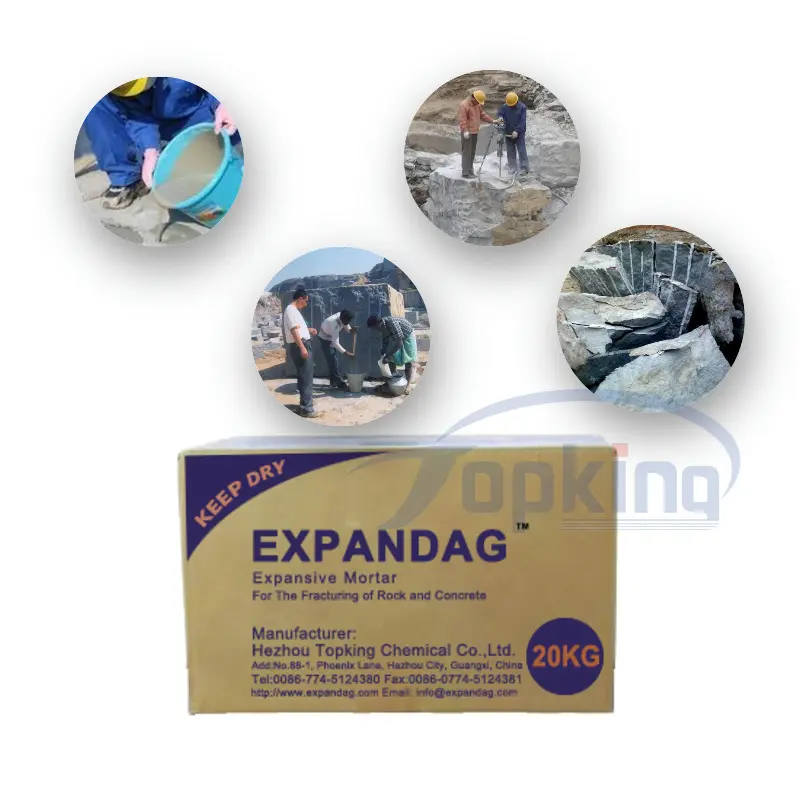
EXPANDAG packaging: 20kg retail carton or 1-tonne bulk bag
Frequently Asked Questions
Q: How Long Does Expansive Mortar Take to Crack Rock at 30°C?
At 30°C ambient temperature, expansive mortar using HSCA-1 (hot weather grade) typically shows first visible cracks within 2–4 hours and achieves full block separation within 6–12 hours. Using standard-grade mortar instead of HSCA-1 at this temperature compresses the working window and increases blowout risk — always match the grade to ambient conditions.
Q: How Long Does Soundless Cracking Agent Take to Work in Cold Weather?
In cold conditions between -5°C and 10°C, soundless cracking agent (HSCA-3) requires 12–24 hours for first visible cracks and up to 48 hours for full separation in hard rock. Using warm mixing water at 20°C–30°C and insulating boreholes with thermal blankets immediately after filling can reduce this to 10–16 hours in mild cold conditions.
Q: Can I Speed Up Expansive Mortar Crack Time?
In cold conditions: yes — use warm mixing water (20°C–30°C) and insulate boreholes after filling. In standard or hot conditions: the crack time is already near minimum for safe operation. Using a lower-grade product in warmer conditions to force a faster reaction increases blowout risk significantly. The 4–6 hour standard window is the controlled pressure development that makes the cracking safe.
Q: How Long Does Expansive Mortar Take to Crack Granite Specifically?
In granite, at standard 10°C–25°C conditions, expansive mortar typically shows first visible surface cracks within 5–8 hours rather than the 4–6 hour average across mixed rock types. Granite's higher tensile strength (7–25MPa) requires more expansion pressure to reach before a crack becomes visible — the reaction isn't slower, the surface signal just arrives later. Full separation still typically completes within 24 hours.
Q: Can Rain Affect Expansive Mortar Crack Time?
Light rain after boreholes are filled has minimal effect, since the reaction happens sealed inside the hole. Heavy rain before filling can matter more — if it cools the rock mass or pools in an open borehole and dilutes the mix during filling. Cover open boreholes ahead of a forecast rain event, and never fill into standing water.
Q: Can I Leave Expansive Mortar Overnight?
Yes. Filled boreholes can sit undisturbed overnight — in cold-weather HSCA-3 applications this is standard practice, since crack initiation alone can take 12–24 hours. The caution runs the other way: don't leave a prepared, dry borehole open overnight before filling it, since moisture or debris intrusion can affect the reaction once mortar goes in.
Q: Why Do Contractors Choose EXPANDAG as an Expansive Mortar Supplier?
EXPANDAG produces HSCA directly at its own factory in China and pre-grades every batch into HSCA-1, HSCA-2, or HSCA-3 before export, matched to the buyer's climate. Factory-direct pricing, engineering support for borehole layout and spacing, and both 20kg carton and 1-tonne bulk bag packaging make EXPANDAG a standard supplier for quarry and demolition contractors across the Middle East, Africa, and Southeast Asia.
Final Engineering Verdict
4–6 hours is the number to plan a shift around at standard temperature — but it's a midpoint, not a guarantee. Grade selection matched to ambient temperature is what keeps that window real; everything else (water ratio, spacing, borehole insulation) is a correction for when conditions drift from standard. Granite will always show its cracks later than limestone at the same pressure curve. That's formation, not a fault in the product. When in doubt, check EXPANDAG's grade chart before the truck leaves the yard, not after the crew is standing at an unopened borehole wondering why nothing happened.
See how our South Korean customer verified crack timing during an on-site field test: South Korean customer field verification.
Related Guides
Technical Note
The timelines presented in this guide are based on EXPANDAG field testing and customer applications across quarry, mining, and demolition projects. Actual crack initiation time may vary depending on rock integrity, borehole geometry, ambient temperature, and application procedures.