 EN
EN
 AR
AR
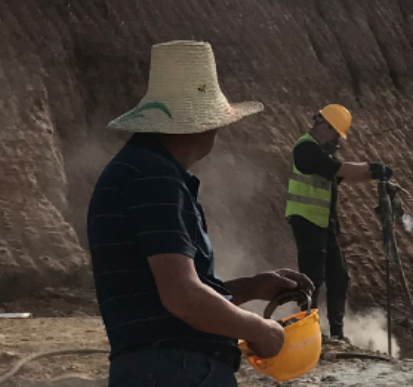
In a typical tunneling application in Oman's Hajar Mountains, contracting crews drilling horizontal blastholes in Grade 8-10 dolomite commonly report rod jamming past 2.5m depth. The rock drill on site is often rated for general tunneling work, not the higher torque output needed once the formation hardens at depth. Switching to a heavier-duty air-leg model with a larger cylinder bore resolves the jamming pattern within the first shift in most cases. The failure isn't the operator. It's model selection.
Which Air-Leg Rock Drill Should You Choose?
Direct Answer
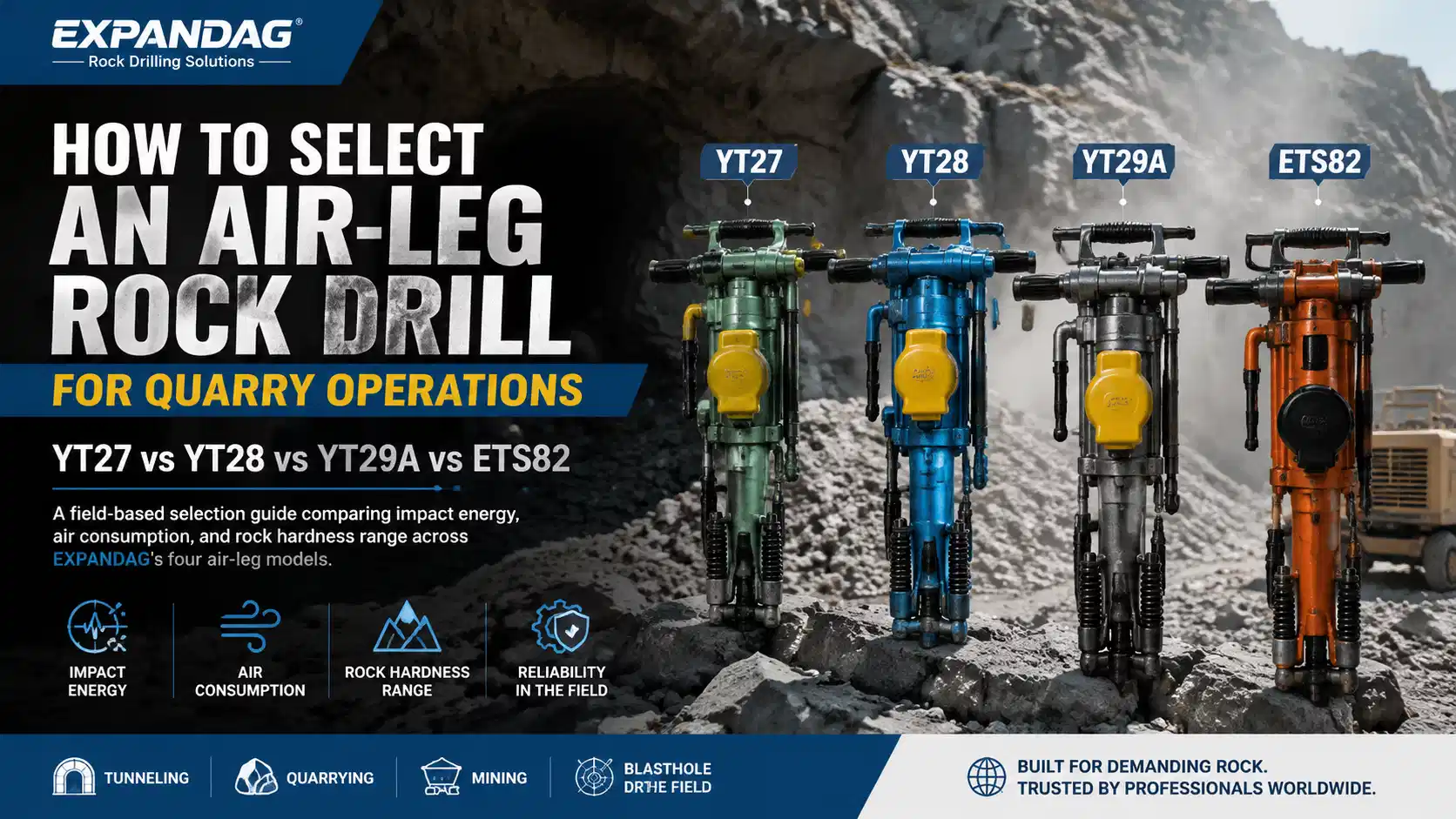
The right EXPANDAG air-leg rock drill depends on rock hardness and drilling depth, not budget alone. The YT27 (≥75.5J impact energy) suits medium-hard rock (f=8-18) and entry-level tunneling budgets. The YT28 (≥70J, ≤81L/s air consumption) is the standard choice for general tunneling and remains the most widely deployed model in the series. The YT29A (≥78J, 82mm cylinder bore, ≥20N·m torque) is built for deep blastholes and super-hard rock where rod jamming is a risk. The ETS82 (≥78J, 39Hz impact frequency) targets high-speed penetration rather than raw torque, suited to production drilling where cycle time matters more than depth. All four run on 0.4-0.63MPa compressed air and pair with FT160/FT170 air legs.
What Are the Technical Specifications of Each Model?
Each of the four models occupies a distinct performance tier. The specification differences below determine which model handles a given rock formation without excessive bit wear or jamming.
| Model | Weight | Impact Energy | Air Consumption | Operating Pressure | Rock Hardness (f-value) |
|---|---|---|---|---|---|
| YT27 | 27 kg | ≥75.5 J | — (0.5-0.63MPa rated) | 0.5-0.63 MPa | f=8-18 |
| YT28 | 26 kg | ≥70 J | ≤81 L/s | 0.4-0.63 MPa | f=8-18 |
| YT29A | 27 kg | ≥78 J | ≤88 L/s | 0.4-0.63 MPa | f=8-18 (super-hard capable) |
| ETS82 | 26.5 kg | ≥78 J | — (39Hz @ rated pressure) | 0.4-0.63 MPa | f=8-18 |
The YT29A and ETS82 share the same ≥78J impact energy rating, which surprises buyers expecting a straight power hierarchy across the range. The difference isn't force. It's how that force is delivered.
What Is the Difference Between the YT29A and ETS82 If Both Deliver ≥78J?
The YT29A reaches ≥78J through a larger 82mm cylinder bore and higher torque (≥20N·m), which resists rod jamming in deep or super-hard formations. The ETS82 reaches the same ≥78J through a higher impact frequency (39Hz), which favors faster penetration rate over raw torque resistance.
In practice: a crew drilling 4-5m holes in fractured, mixed-hardness rock where the bit periodically meets harder inclusions should default to the YT29A — the torque keeps the rod turning instead of stalling. A crew doing high-volume production drilling in consistent rock, where every minute of cycle time compounds across dozens of holes per shift, gets more value from the ETS82's higher frequency. Torque solves jamming. Frequency solves throughput. They are not interchangeable fixes.
Why Is the YT28 Still the Most Widely Deployed Air-Leg Drill?
The YT28 is not the strongest model in the range — its ≥70J impact energy sits below both the YT29A and ETS82. It remains the standard choice for general tunneling because most blasthole drilling doesn't require peak torque or peak frequency; it requires reliable, moderate output at a lower air consumption (≤81L/s versus the YT29A's ≤88L/s), which means a smaller compressor keeps it running.
For railway, highway, and hydropower tunneling in f=8-18 rock without unusual jamming risk, the YT28's lower air demand reduces compressor sizing costs across a multi-drill crew. Buying the heaviest-duty model for a job that doesn't need it wastes compressed air capacity that could run a second drill instead.
What Air Compressor Size Does Each Model Require?
Air compressor sizing scales directly with each model's air consumption at 0.63MPa working pressure. Undersizing the compressor is the single most common cause of "weak drill" complaints — the drill itself is rarely at fault.
| Model | Air Consumption @ 0.63MPa | Minimum Compressor Output |
|---|---|---|
| YT28 | ≤81 L/s | ≥5 m³/min (approx. 175-180 CFM) |
| YT29A | ≤88 L/s | ≥5.5 m³/min (approx. 190 CFM) |
Running two drills off one compressor without recalculating total demand is a frequent field mistake. A single compressor rated for one YT29A cannot reliably supply two units at once — impact energy drops across both drills simultaneously, and neither performs at its rated spec.
Field Insight from EXPANDAG Engineers
Contractors sourcing air-leg drills for the first time often default to whichever model has the highest impact energy number, assuming more force always means faster drilling. It doesn't. A YT29A run on an undersized compressor delivers less real-world performance than a correctly-supplied YT28. Match the compressor to the drill before matching the drill to the rock — an underpowered air supply erases every advantage the heavier-duty models are built for. In desert conditions above 40°C, increase FY250 lubricator checks to every 2 hours of continuous operation; heat accelerates valve wear regardless of which model is running.
In Saudi Arabia's Vision 2030 tunnel and road projects, crews drilling granite outcrops in ambient temperatures exceeding 45°C see the fastest valve degradation of any climate condition EXPANDAG ships into — lubrication discipline matters more there than model selection. UAE infrastructure tunneling shows a similar pattern: dust ingress, not heat alone, is the more common failure driver, since fine desert sand works past seals faster than it does in more humid climates.
West African gold mine drilling presents a different constraint entirely. Remote sites without reliable compressed-air infrastructure make air consumption the deciding factor before impact energy is even considered — a YT28's ≤81L/s demand is often the only option a site's compressor capacity can sustain, regardless of whether a YT29A would drill faster in ideal conditions. Parts availability compounds this: crews in remote African quarry operations favor whichever model their nearest regional distributor stocks consistently, since a jammed rod with no replacement piston on hand costs more downtime than a slightly slower drill ever would. Low total cost of ownership, in these conditions, means simple maintenance and predictable spare parts — not peak specification.
In Andean quarrying across Peru, Colombia, and Brazil, altitude changes compressor output in ways that catch first-time buyers off guard. A compressor rated for 190 CFM at sea level delivers meaningfully less at 3,000m elevation due to reduced air density, which means a YT29A calculated as adequately supplied at sea-level specs can run underpowered at altitude. Crews working Andean marble and granite quarries should size compressors against altitude-adjusted output, not the nameplate rating alone — and where noise restrictions apply to urban demolition, pairing any of these four models with HSCA for the blasthole pattern avoids blast permitting entirely.
What Drilling Rate and Maintenance Interval Should You Expect?
Drilling rate in granite (f=10-14) typically runs 250-400mm/min for the YT28, rising to 350-450mm/min for the YT29A and ETS82 under correctly matched air supply — the exact rate depends on bit condition, water flushing consistency, and rock uniformity as much as the drill itself. These figures assume a sharp tapered bit; a worn bit past its service interval can cut penetration rate by a third regardless of which model is running.
Maintenance intervals follow a similar pattern across all four models. Line oiler (FY250) reservoirs should be checked at the start of every shift and topped up at minimum every 4 hours of continuous operation — halved to every 2 hours above 40°C ambient temperature. Air leg seals (FT160/FT170) warrant visual inspection weekly under normal use, and immediately if the leg fails to hold feed pressure. Cylinder and piston wear becomes noticeable as a drop in impact energy before it becomes audible as vibration — tracking drilling rate over time is a more reliable early warning than waiting for the drill to sound different.
Can These Air-Leg Drills Be Used for HSCA Blasthole Preparation?
Yes. All four models drill the 30-42mm hole diameter required for HSCA (Soundless Cracking Agent) expansive mortar, making them suitable for silent, non-explosive quarrying where blast permits are restricted or unavailable. Drill the pattern with the air-leg rock drill, then fill with HSCA for vibration-free block extraction.
This pairing is common in marble and granite quarrying across Brazil, Colombia, and Peru, where urban proximity or environmental regulation limits conventional blasting. The YT28 is the standard choice for this workflow at typical quarry rock hardness (f=8-14); the YT29A is reserved for harder granite formations where standard-grade drills show excessive bit wear before reaching HSCA's required hole depth.
What Causes Rod Jamming and How Do You Prevent It?
Rod jamming in air-leg drilling almost always traces to one of four causes, and the fix is rarely "drill harder."
| Problem | Likely Cause | Recommended Corrective Action |
|---|---|---|
| Rod jams past 2-3m depth | Insufficient rotation torque for formation hardness | Upgrade to YT29A (≥20N·m torque, 82mm bore) |
| Weak impact, slow penetration | Undersized air compressor for the model | Verify compressor output against the model's rated L/s at 0.63MPa |
| Drill overheats after 2-3 hours | Insufficient lubrication (FY250/FY200B) | Check line oiler every 2 hours in ambient temperatures above 40°C |
| Air leg won't hold feed position | FT160/FT170 seal wear or low air pressure to the leg | Inspect air leg seals; confirm leg receives full line pressure, not a reduced branch |
| Water not flushing the hole | Blocked water tube or water valve failure | Stop drilling immediately; dry drilling accelerates bit and bore wear |
Which Model Should You Choose for Your Application?
| Application | Recommended Model | Reason |
|---|---|---|
| Entry-level tunneling, moderate budget | YT27 | ≥75.5J is sufficient for f=8-18 rock without deep-hole jamming risk |
| General tunneling, railway/highway/hydropower | YT28 | Lowest air demand (≤81L/s) for the reliability it delivers; most widely deployed for this reason |
| Deep blastholes, super-hard or fractured rock | YT29A | 82mm bore and ≥20N·m torque prevent rod jamming where other models stall |
| High-volume production drilling, consistent rock | ETS82 | 39Hz frequency cuts cycle time per hole across high hole counts |
| HSCA blasthole preparation, standard quarry rock | YT28 | Matches 30-42mm HSCA hole diameter at typical quarry hardness (f=8-14) |
Hard rock demands more than 75J. The YT29A does not jam. Frequency beats torque only when the rock stays consistent.
A common mis-selection pattern worth flagging directly: contractors moving from hand-held rock drills to their first air-leg model often default to the YT27 purely because it's the lightest entry point in the range, without checking whether their formation's f-value actually falls within its comfortable operating band. The YT27, YT28, and YT29A all cover the same nominal f=8-18 rock hardness range on paper — but "covers" and "performs efficiently in" are not the same claim. A YT27 running continuously at the top end of f=18 rock will show faster bit wear and slower net penetration than a YT29A running the same formation, even though both are technically rated for it. Rated range tells you what a drill can survive; it doesn't tell you where a drill is efficient. For rock consistently above f=14, treat the YT29A as the practical floor rather than the ceiling.
Quick Technical Summary
YT27: ≥75.5J impact energy, entry-level pusher leg, f=8-18 rock
YT28: ≥70J impact energy, ≤81L/s air consumption, most widely deployed model
YT29A: ≥78J impact energy, 82mm cylinder bore, ≥20N·m torque, ≤88L/s air consumption
ETS82: ≥78J impact energy, 39Hz impact frequency, optimized for penetration speed
Compatible air legs: FT160, FT170 (all four models)
Operating pressure range: 0.4-0.63 MPa across the series
HSCA-compatible hole diameter: 30-42mm
Frequently Asked Questions
Q: What Is the Difference Between an Air-Leg Rock Drill and a Hand-Held Rock Drill?
An air-leg rock drill is mounted on a pneumatic leg (FT160/FT170) that absorbs recoil and provides forward feed pressure, allowing horizontal or upward drilling of deep blastholes (up to 5m) with reduced operator fatigue. A hand-held rock drill is operated entirely by the user, suited to shallower holes and lighter demolition work where the recoil is manageable without mechanical support.
Q: Can I Run Two Air-Leg Drills Off One Compressor?
Only if the compressor's total output exceeds the combined L/s demand of both drills at your working pressure. Running two YT28 units (≤81L/s each) requires a compressor rated for at least 162L/s combined — undersizing causes both drills to lose impact energy simultaneously rather than one drill failing outright.
Q: How Long Does a Tapered Drill Bit Last in Granite With These Drills?
Bit life depends more on rock abrasiveness and correct flushing than on which air-leg model is used, but insufficient torque (using a YT27 or YT28 where a YT29A is needed) forces the bit to grind rather than fracture the rock cleanly, accelerating wear regardless of bit quality. Correct model-to-rock matching is the first step in extending bit life.
Q: Do These Air-Leg Drills Require Wet Drilling?
Wet drilling is standard practice for all four models in production quarrying — the water flushes cuttings from the hole and cools the bit. Dry drilling accelerates bit wear and increases silica dust exposure; where water supply is limited, water consumption must still be maintained rather than eliminated.
Q: Why Source Air-Leg Rock Drills Through EXPANDAG Rather Than Direct From a Drill Factory?
EXPANDAG sources YT27, YT28, YT29A, and ETS82 units from established pneumatic drill manufacturers, then applies engineering selection support, quality checks, and consolidated export logistics for buyers who are also ordering HSCA expansive mortar. For contractors running both a drilling program and an HSCA-based quarrying workflow, this means one supplier, one shipment, and one point of contact for spare parts across both product lines — rather than sourcing rock drills and HSCA from two unrelated vendors.
Final Engineering Verdict
For most general tunneling work in f=8-18 rock, the YT28 remains the correct default — its lower air consumption reduces compressor overhead across a multi-drill crew without sacrificing the impact energy that standard blasthole patterns require. Reserve the YT29A specifically for jobs where rod jamming has already been a problem or where the formation includes harder inclusions; its torque advantage, not its impact energy, is what solves that failure mode. Choose the ETS82 only when cycle time across high hole counts matters more than resistance to jamming, and treat the YT27 as the entry point for lighter-duty tunneling budgets rather than a compromise on all fronts. No model substitutes for correct compressor sizing — verify air supply capacity before comparing impact energy figures.