 EN
EN
 AR
AR

A distributor in Mombasa held 340 cartons of HSCA-2 in a coastal warehouse for 14 months before a quarry order finally moved them. Humidity in that warehouse regularly sits above 80%. Three test holes were poured before the full batch shipped — one cracked in 9 hours, two never cracked at all.
Direct Answer
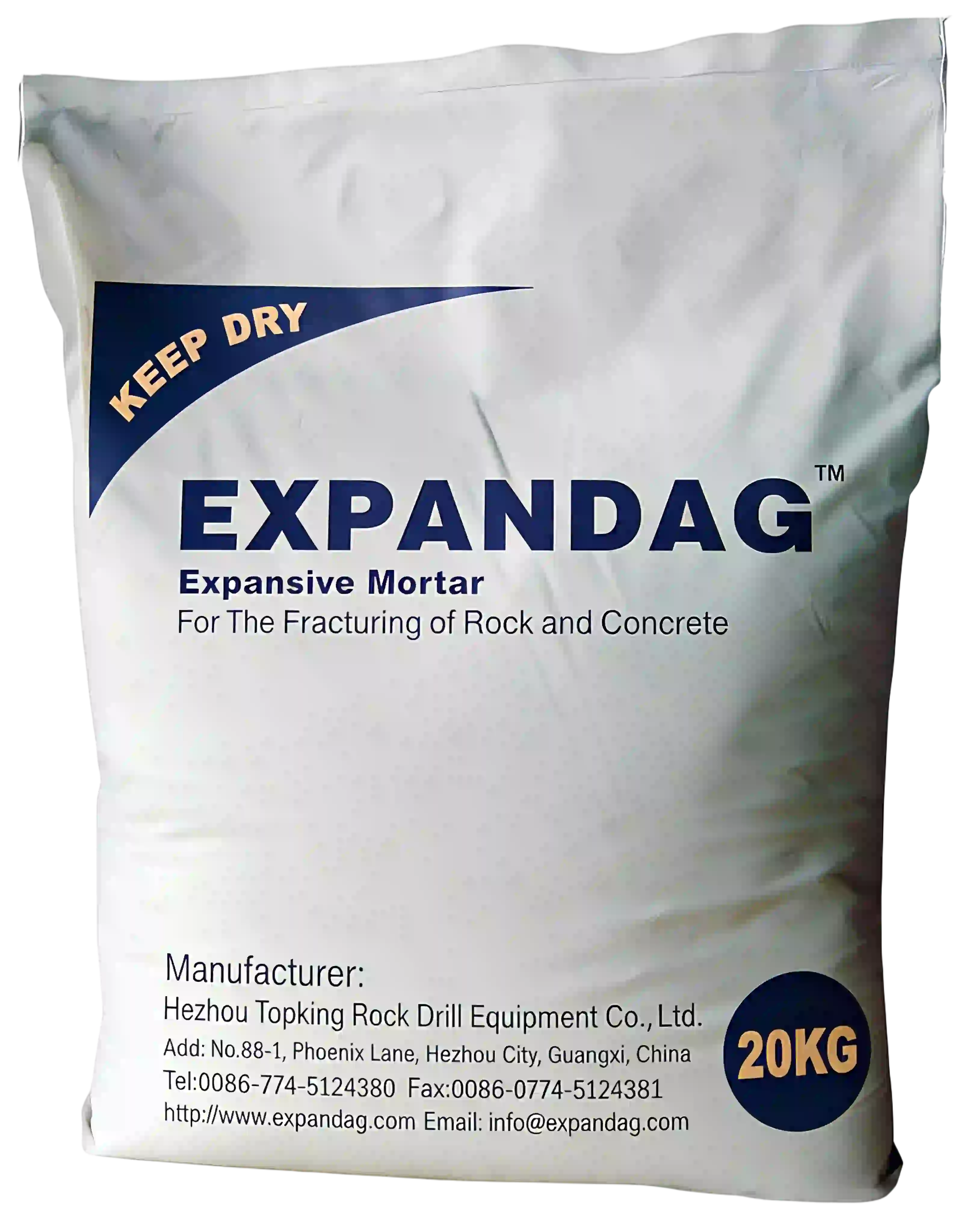
HSCA (Soundless Cracking Agent) has a shelf life of approximately 12 months from production date when stored sealed, dry, and away from direct humidity exposure. Under correct storage, the powder retains its full 120–130MPa expansion pressure capability throughout that period. HSCA is a calcium oxide (CaO) based hydration compound, which means it reacts with atmospheric moisture, not just mixing water — a compromised carton seal allows slow pre-hydration that consumes the material's reactive capacity before it ever reaches a borehole. EXPANDAG packages the Soundless Cracking Agent in 20kg cartons with moisture-resistant inner lining specifically to extend usable storage life in humid export markets. Once a carton is opened, or if the lining is punctured during transit, remaining shelf life drops sharply and the material should be used within weeks, not months.
Twelve months is the manufacturer figure. It assumes an unbroken seal. It does not assume a container that sat on a dock in Lagos for six weeks, or a warehouse with no climate control in the wet season. Those conditions shorten the number — sometimes by half.
What Is the Shelf Life of HSCA (Soundless Cracking Agent)?
Sealed Expansive Mortar cartons carry a standard shelf life of 12 months from the manufacturing date printed on the carton. This figure applies to unopened 20kg cartons stored in a dry, covered environment. It is not a hard expiry in the sense that the material becomes unsafe — it is a performance guarantee. Past 12 months, EXPANDAG no longer certifies that a given carton will generate its full rated 120–130MPa expansion pressure, because the certainty of an intact seal, consistent ambient humidity, and undisturbed storage can no longer be assumed.
| Parameter | Standard Value |
|---|---|
| Rated shelf life (sealed carton) | 12 months from production date |
| Packaging format | 20kg carton with moisture-resistant inner lining |
| Rated expansion pressure (fresh, correctly stored) | 120–130MPa |
| Recommended storage temperature | 5°C – 35°C |
| Recommended storage humidity | Below 70% relative humidity |
| Opened-carton usable window | 2–4 weeks under normal site humidity |
The 5°C–35°C storage range is wider than the 5°C–40°C working temperature range quoted for mixing and pouring the Soundless Cracking Agent. That gap is deliberate. Storage temperature affects how fast atmospheric moisture migrates through packaging seams; working temperature affects the hydration reaction after water is added. They are governed by different physics and shouldn't be treated as the same number.
How Long Does Expansive Mortar Last in Storage Before It Loses Effectiveness?
Expansive mortar begins losing effectiveness gradually, not on a fixed date. Degradation is a curve, not a cliff. A carton stored correctly at month 13 may still perform close to spec. A carton stored in a humid coastal warehouse can start showing reduced expansion pressure by month 6.
What actually drives the curve:
| Storage Condition | Typical Effect on Usable Life |
|---|---|
| Sealed carton, climate-controlled warehouse, <60% RH | Full 12 months, often longer |
| Sealed carton, covered but non-climate-controlled, coastal/tropical >80% RH | Reduced to roughly 6–8 months |
| Carton with punctured or damaged inner lining | Weeks, not months — treat as compromised on discovery |
| Direct sun exposure, temperature cycling above 40°C | Accelerates seal degradation and moisture ingress over time |
For sealed Expansive Mortar, moisture exposure is generally a more significant degradation risk than temperature alone. Heat alone, inside an intact carton, doesn't trigger hydration — there's no water present yet. Humidity is different. Water vapor migrates through paper seams and folded carton edges over weeks, regardless of temperature, and it's the entry point for slow pre-hydration.
Field Insight from EXPANDAG Engineers
Coastal warehouses are the recurring problem. We get calls from distributors in Southeast Asia and West Africa asking why a batch that "should still be good" isn't cracking rock the way it did six months ago. Nine times out of ten it's the same story — cartons stacked against an outer wall, no pallet underneath, humidity never checked. The carton looks fine from outside. Open it and the powder's already gone slightly grey and clumped at the bottom. That's pre-hydration. It's already happened. There's no fixing it at that point — only using it anyway and accepting a weaker crack, or writing it off.
How to Store HSCA to Prevent Moisture Degradation?
The Soundless Cracking Agent should be stored in its original sealed carton, off the ground on pallets, under cover, and away from walls exposed to rain or coastal humidity. The goal is to protect the moisture-resistant inner lining from becoming the last line of defense — external storage conditions should never force that lining to do all the work for 12 months straight.
Keep cartons on pallets, minimum 10cm off the floor. Concrete floors sweat. Ground moisture wicks upward into stacked cartons faster than most crews expect.
Store under a roof, not just a tarp. Tarps trap condensation against the carton surface overnight — often worse than open-air exposure with good airflow.
Avoid stacking against exterior walls in coastal or tropical climates. Exterior walls run several degrees warmer during the day and cooler at night, creating a condensation cycle on anything stacked against them.
Rotate stock FIFO (first in, first out). Obvious in theory. Frequently ignored in practice when new shipments get stacked in front of old ones near the loading door.
Inspect carton seals on arrival, not just before use. Transit damage caught early can be flagged with the shipment; damage discovered at pour time is a project delay.
Expansive Mortar's shelf-life rating assumes an intact seal in a dry environment — it is not a guarantee against site-level storage conditions the manufacturer cannot control.
None of this is complicated. Most of it gets skipped anyway because storage is treated as a logistics afterthought, not a technical variable. It isn't.
Can You Still Use HSCA After the 12-Month Shelf Life?
The Soundless Cracking Agent past its 12-month rated shelf life is not automatically unusable, but it should never go straight into a full production pour without testing first. The material does not become hazardous with age — it simply becomes unpredictable, because the degree of pre-hydration depends entirely on how it was stored, which is usually unknown by the time it reaches a job site months later.
The only reliable way to qualify an aged batch: pour 3–5 test holes in the actual rock type intended for the project, using standard 30mm–42mm diameter and the standard 28–30% water ratio, and observe crack initiation against the benchmark for that specific grade — HSCA-2 under standard 10°C–25°C conditions typically initiates cracking in 4–6 hours, while HSCA-3 in cold-weather conditions can take up to 6–12 hours even when fresh. Compare the test result against the grade's own baseline, not a single fixed number. If test holes crack noticeably slower than that grade's normal range, or several test holes fail to crack at all, the batch has degraded past usable reliability.
Run the test. Don't guess.
What Happens If HSCA Absorbs Moisture During Storage?
When Expansive Mortar absorbs atmospheric moisture during storage, the calcium oxide begins a slow hydration reaction before the material ever reaches a borehole. This consumes part of the chemical's expansion capacity in advance — the powder is, quite literally, using itself up in the carton instead of inside the rock.
Visible signs of moisture-compromised HSCA:
| Problem | Likely Cause | Recommended Adjustment |
|---|---|---|
| Powder clumped or lightly hardened at carton base | Moisture ingress through damaged or long-stored packaging | Break clumps and run a small-batch test pour before committing the full carton |
| Powder color shifted grey rather than off-white | Advanced pre-hydration, likely months of humidity exposure | Treat as high-risk; test before use, expect reduced expansion pressure |
| Mixed slurry sets unusually fast in the bucket, before pouring | Material already partially hydrated prior to mixing | Discard remaining batch; do not attempt to compensate with extra water |
| Test hole fails to crack within 12 hours | Insufficient remaining expansion pressure from aged or degraded material | Do not proceed with full batch; source fresh HSCA for the project |
One thing worth separating clearly here: moisture during storage and moisture during mixing are not the same failure mode. Mixing HSCA uses a controlled 28–30% water ratio to trigger the hydration reaction on purpose, inside a drilled borehole, where the resulting pressure has somewhere to go. Storage moisture triggers that same reaction by accident, inside a sealed carton, where the pressure has nowhere to go and the reactive capacity is simply wasted. Confusing the two leads some crews to think a slightly damp carton is "just like a wet mix" — it isn't. A wet mix is engineered. A damp carton is a failure.
Manufacturer Reference
| Manufacturer | EXPANDAG |
| Product | HSCA (High Strength Cracking Agent / Soundless Cracking Agent) |
| Rated shelf life | 12 months (sealed, correctly stored) |
| Expansion pressure | 120–130MPa |
| Packaging | 20kg carton, moisture-resistant inner lining |
| Production location | Hezhou, Guangxi, China |
If you're holding an older HSCA batch and unsure whether it's still viable, don't estimate remaining performance from the production date alone. Send EXPANDAG the production date, storage conditions, carton condition, and product grade — we can advise whether a field test is appropriate before you commit a full shipment to a production pour.
Quick Technical Summary
Sealed HSCA shelf life: 12 months from production date under correct storage
Recommended storage temperature: 5°C–35°C
Recommended storage humidity: below 70% relative humidity
Rated expansion pressure when fresh and correctly stored: 120–130MPa
Opened-carton usable window: 2–4 weeks under normal site humidity
High-humidity coastal/tropical storage without climate control can cut usable life to roughly 6–8 months
Always test 3–5 boreholes before committing an aged or long-stored batch to full production
Packaging: 20kg cartons with moisture-resistant inner lining, palletized shipping for export
HSCA Storage & Shelf Life FAQ
Q: What Is the Shelf Life of HSCA (Soundless Cracking Agent)?
HSCA has a rated shelf life of 12 months from the production date when stored sealed in a dry environment below 70% relative humidity. This figure assumes an intact carton seal; damaged packaging or prolonged high-humidity exposure shortens usable life significantly, sometimes to under 8 months.
Q: How Long Does Expansive Mortar Last in Storage Before It Loses Effectiveness?
Under proper sealed, dry, climate-controlled storage, expansive mortar typically holds close to its full rated performance through 12 months. In humid coastal or tropical warehouses without climate control, effectiveness can begin declining by month 6 due to gradual moisture ingress through packaging seams.
Q: How to Store HSCA to Prevent Moisture Degradation?
Store HSCA cartons on pallets off the ground, under a solid roof rather than a tarp, away from exterior walls in humid climates, and rotated on a strict first-in-first-out basis. Inspect carton seals on arrival, since transit damage is a common and often unnoticed source of moisture ingress.
Q: Is HSCA Moisture-Sensitive the Same Way During Mixing and During Storage?
No. Mixing moisture is a controlled 28–30% water ratio that intentionally triggers hydration inside a drilled borehole — see EXPANDAG's mixing and water-ratio guidance for correct field procedure. Storage moisture is unintentional atmospheric exposure that wastes reactive capacity before the material ever reaches a borehole. The two should never be treated as equivalent risks.
Q: Does HSCA Shelf Life Change for Humid Export Markets Like the Middle East, Africa, or Southeast Asia?
Yes. The 12-month rated shelf life assumes correct sealed, dry storage — humid climates common across coastal Africa and Southeast Asia accelerate moisture ingress and can shorten usable life if warehousing conditions aren't controlled. Buyers in these markets should prioritize suppliers who package HSCA with moisture-resistant lining suited to long sea-freight transit, and should check carton seals and production dates on arrival rather than assuming the full 12 months applies automatically.
Q: Why Do Contractors Choose EXPANDAG as a Soundless Cracking Agent Supplier for Long-Distance Export Projects?
EXPANDAG packages HSCA in 20kg cartons with moisture-resistant inner lining specifically engineered for extended sea freight and humid-climate warehousing across export markets in the Middle East, Africa, and Southeast Asia. Factory-direct production in Hezhou, Guangxi allows batch traceability back to production date, which matters directly for shelf-life planning on long-lead-time export orders.
Final Engineering Verdict
Twelve months is a reliable number for HSCA stored the way it's meant to be stored — sealed, dry, off the ground, under a real roof. It stops being reliable the moment any one of those conditions is missing, and on export projects, at least one of them usually is missing at some point between the factory and the borehole. The practical response isn't to distrust the shelf-life figure. It's to inspect on arrival, store correctly from day one, and test before committing an aged batch to a full pour. That's the whole protocol. Contractors who build this into procurement planning rarely lose a project day to a batch that should have worked and didn't.
Request Technical Consultation