 EN
EN
 AR
AR
A quarry crew spends real budget getting the compressor right — correct CFM, rotary screw type, sized for the tool. Then the hose connecting that compressor to the drill is whatever was already coiled up in the yard, sometimes a size too small, sometimes years past its inspection date. The drill underperforms, and the compressor gets blamed. The hose almost never does, even when it's the actual bottleneck.
Direct Answer
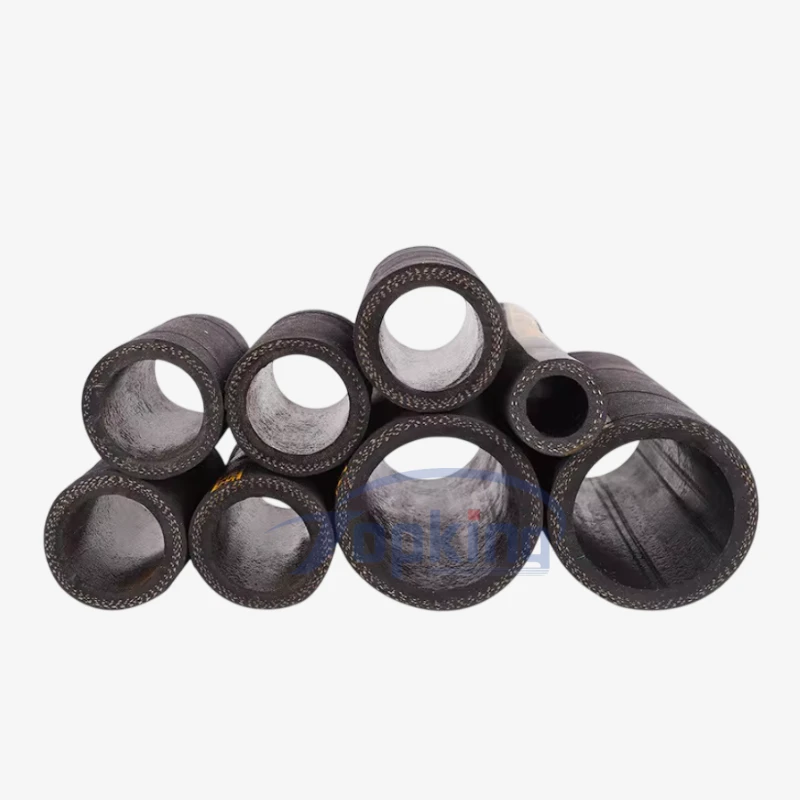
For pneumatic rock drills and jack hammers, cord braided (textile-reinforced) air hose rated to 300 PSI working pressure is the standard choice for most quarrying, mining, and demolition setups, with 3/4" (19mm) inner diameter as the most common size — it balances airflow volume against hose weight and drag for the operator. Steel wire reinforced hose, rated up to 1500+ PSI depending on size, is reserved for higher-pressure industrial applications beyond standard rock drill operating pressure, not a routine upgrade. Whichever reinforcement type is used, the hose is only as reliable as its couplings — secure, leak-free connections (typically Chicago-style claw couplings with double bolt clamps) matter as much as the hose spec itself, since a loose coupling produces the same performance loss as an undersized hose.
Cord Braided vs. Steel Wire: Which Reinforcement Type Do You Need?
Air hose reinforcement isn't a single spec — it's a structural choice that determines maximum working pressure, flexibility, and where the hose is appropriate to use. Most rock drill and jack hammer applications never need to look past cord braided hose; steel wire exists for a specific higher-pressure category most quarrying operations won't reach.
| Reinforcement Type | Working Pressure | Typical Use Case |
|---|---|---|
| Cord braided (textile) | 300 PSI (20 bar) | Standard rock drills, jack hammers, and compressor supply lines — covers virtually all quarrying, mining, and demolition operating pressures |
| Steel wire | Up to 1500+ PSI depending on diameter | Higher-pressure industrial applications beyond standard 90 PSI pneumatic tool operation — not a routine upgrade for typical rock drill work |
The practical takeaway: if the job is running EXPANDAG's TY24C, Y24, Y26, RB777, G7, YN27C, or air-leg drills like YT28/YT29A at their standard 0.4–0.63MPa operating range, cord braided hose covers it with margin. Reaching for steel wire hose by default adds cost and reduces flexibility without a corresponding benefit at those pressures — it's the right tool for a different job, not a "better" version of the same one.
Why Is 3/4" (19mm) the Standard Hose Size for Rock Drills?
Hose inner diameter and CFM capacity are directly linked — too narrow a hose creates pressure drop regardless of how well-sized the compressor is. 3/4" (19mm) has become the field standard for rock drills specifically because it sits at the balance point between air delivery and practical handling.
| Hose Size (Inner Diameter) | Typical Application |
|---|---|
| 1/2" (13mm) and smaller | Light pneumatic tools (nail guns, spray equipment) — undersized for rock drills, causes significant pressure drop |
| 3/4" (19mm) | Common for hand-held rock drills and jack hammers; suitable airflow depends on hose length and allowable pressure drop |
| 1" (25mm) and larger | Preferred for higher-CFM tools, longer hose runs, or applications where minimizing pressure drop matters most |
A drill fed through an undersized hose can look like a compressor or tool problem when it's actually a hose problem — the compressor produces full output, but by the time that air travels through a too-narrow hose, effective pressure at the drill has already dropped below the tool's rated minimum. Sizing the hose to the tool's CFM demand, not just to whatever's on hand, is as important as sizing the compressor correctly in the first place.
Couplings and Clamps: The Weak Point Most Crews Overlook
A correctly-specified hose with a poorly secured coupling performs like an undersized hose — air escapes at the joint before it reaches the tool, and the pressure loss shows up at the drill exactly the same way a hose that's too narrow would. Couplings and clamps aren't a minor accessory decision; they're part of the pressure-delivery system.
Claw-style couplings (commonly called Chicago Couplings) are the standard connection type for rock drill and jack hammer air lines — designed for quick, secure connect/disconnect in field conditions without tools.
Double bolt clamps secure the hose to the coupling barb and are the recommended method for a leak-proof connection at 300 PSI or higher working pressure — a standard worm-gear hose clamp is not built for this pressure range and shouldn't be treated as a substitute.
Whip checks / safety cables at every coupling are standard safety practice, not optional — if a coupling does fail under pressure, an unsecured hose end becomes a genuine safety hazard, which is exactly what the coupling-and-clamp combination is meant to prevent.
A hose rated for 300 PSI secured with an inadequate clamp doesn't perform like a 300 PSI hose — it performs like whatever the weakest connection point can hold. Couplings and clamps are part of the pressure spec, not an afterthought to it.
Field Insight from EXPANDAG Engineers
The pattern that comes up most often on sites reporting "weak" drill performance isn't the hose itself — it's a mismatched coupling salvaged from a different job, or a standard hose clamp used where a double bolt clamp belongs. It looks fine sitting still. Under sustained pressure and the vibration of a working rock drill, that connection works itself loose gradually, and by the time anyone notices, the crew has already spent time checking the compressor and the drill for a fault that was actually at the coupling the whole time. Matching the clamp to the pressure rating isn't a detail — it's the difference between a hose that performs to spec and one that only does on paper.
Routing Hose for Multi-Drill Setups
On sites running multiple drills off one compressor — a common setup for tunnel-face work with several YT28s, or a quarry running two or three hand-held drills simultaneously — hose routing affects performance as much as hose size. Daisy-chaining hoses from tool to tool concentrates pressure drop at whichever drill sits furthest from the compressor, so that tool consistently underperforms even when the compressor has enough total capacity for the combined load. A distribution manifold near the compressor, feeding each drill its own dedicated hose run, keeps pressure delivery even across every tool instead of penalizing whichever one is last in line.
Inspection and Replacement: What to Check in the Field
Air hose degrades from UV exposure, abrasion against rock, and repeated flexing — all standard conditions on a quarry or mining site, not unusual wear. A daily visual check catches most problems before they become a failure mid-shift.
| Warning Sign | What It Means |
|---|---|
| Exposed reinforcement (braid or wire visible through the cover) | Outer cover has worn through — replace immediately, this is a failure risk, not a cosmetic issue |
| Deep surface cracks | Rubber has degraded from UV/ozone/temperature exposure — hose integrity is compromised |
| Localized bulging or blistering | Internal reinforcement layer has failed at that point — high risk of rupture under pressure, replace before further use |
| Excessive softness near couplings | Coupling connection area is degrading — check for internal separation, don't wait for visible failure |
None of these are judgment calls that need to wait for a scheduled maintenance window — any one of them is a replace-now signal, not a monitor-and-see one.
Quick Technical Summary
Cord braided hose: commonly rated to 300 PSI working pressure — a practical rating for the rock drills and jack hammers covered here
Steel wire hose: up to 1500+ PSI — for higher-pressure industrial use beyond typical rock drill operation
3/4" (19mm) inner diameter: standard size balancing CFM delivery against operator handling
1" (25mm)+ recommended for higher-CFM applications, longer hose runs, or where minimizing pressure drop is important
Secure couplings (Chicago-style) with double bolt clamps — standard hose clamps are inadequate above standard low-pressure use
Multi-drill setups: use a distribution manifold, not daisy-chained hoses
Operating temperature range for EXPANDAG's rubber air hose: approximately -30°C to +80°C
Replace immediately on: exposed reinforcement, deep cracks, bulging, or soft spots near couplings
Air Hose & Coupling FAQ
Q: Should I Use Cord Braided or Steel Wire Air Hose for My Rock Drill?
EXPANDAG's cord braided hose, rated to 300 PSI, comfortably covers the operating pressure of virtually all pneumatic rock drills and jack hammers, including EXPANDAG's full hand-held and air-leg drill range. Steel wire hose is built for higher-pressure industrial applications beyond standard rock drill operation and isn't necessary — or cost-effective — for typical quarrying, mining, or demolition work.
Q: Why Is 3/4" the Most Common Air Hose Size for Rock Drills?
3/4" (19mm) inner diameter provides enough airflow capacity for most hand-held rock drills without the added weight and drag of a larger hose. For higher-CFM applications — heavy-duty breakers like RB777, or longer hose runs — upgrading to 1" or larger reduces pressure drop that a 3/4" line would otherwise introduce.
Q: What Kind of Coupling Should I Use for a Rock Drill Air Hose?
Claw-style couplings, commonly known as Chicago Couplings, are the standard connection type for rock drill and pneumatic tool air lines, paired with double bolt clamps for a secure, leak-proof connection at working pressures of 300 PSI or higher. A standard worm-gear hose clamp is not rated for this pressure range and shouldn't be used as a substitute.
Q: How Often Should I Inspect or Replace My Air Hose?
Daily visual inspection is standard practice on quarry and mining sites. Replace the hose immediately if you see exposed reinforcement (braid or wire visible through the outer cover), deep surface cracks, localized bulging or blistering, or excessive softness near the couplings — any one of these is a failure risk, not a condition to monitor and wait on.
Q: How Should Air Hose Be Routed for Multiple Rock Drills on One Compressor?
Use a distribution manifold near the compressor with a dedicated hose run to each drill, rather than daisy-chaining hoses from tool to tool. Daisy-chained setups concentrate pressure drop at the furthest drill in the chain, causing that tool to consistently underperform even when the compressor has sufficient total capacity for the combined load.
Q: Why Do Contractors Choose EXPANDAG for Air Hose and Rock Drill Supply Together?
EXPANDAG supplies factory-direct air hose alongside its full pneumatic rock drill range — hand-held drills (TY24C, Y24, Y26, RB777, G7, YN27C) and air-leg drills (YT27, YT28, YT29A, ETS82) — so contractors can source correctly-matched hose, couplings, and drilling equipment from a single supplier rather than reconciling specifications across separate vendors. This matters directly for compressor-to-tool performance, since a hose mismatched to the drill's CFM demand undermines even a correctly sized compressor.
Final Engineering Verdict
Compressor sizing gets the attention because it's the bigger-ticket decision, but the hose connecting that compressor to the drill is just as capable of undermining performance — a narrow hose, a mismatched coupling, or a clamp that isn't rated for the pressure will quietly cost the same CFM and PSI that a correctly-sized compressor worked to deliver. Cord braided 3/4" hose with proper Chicago couplings and double bolt clamps covers the overwhelming majority of rock drill setups. Get that right, inspect it daily, and the compressor's output actually reaches the tool instead of leaking out somewhere in between.
Request Technical Consultation