 EN
EN
 AR
AR
A Singapore buyer emailed EXPANDAG last week asking a version of the same question most first-time importers ask eventually: "How do I know this actually works before I commit to a full container?" Two cartons of sample product went out within days. That's the honest answer to most of this article — verification isn't a document you request once and file away, it's a small set of concrete steps that happen before the real order, not after.
Direct Answer
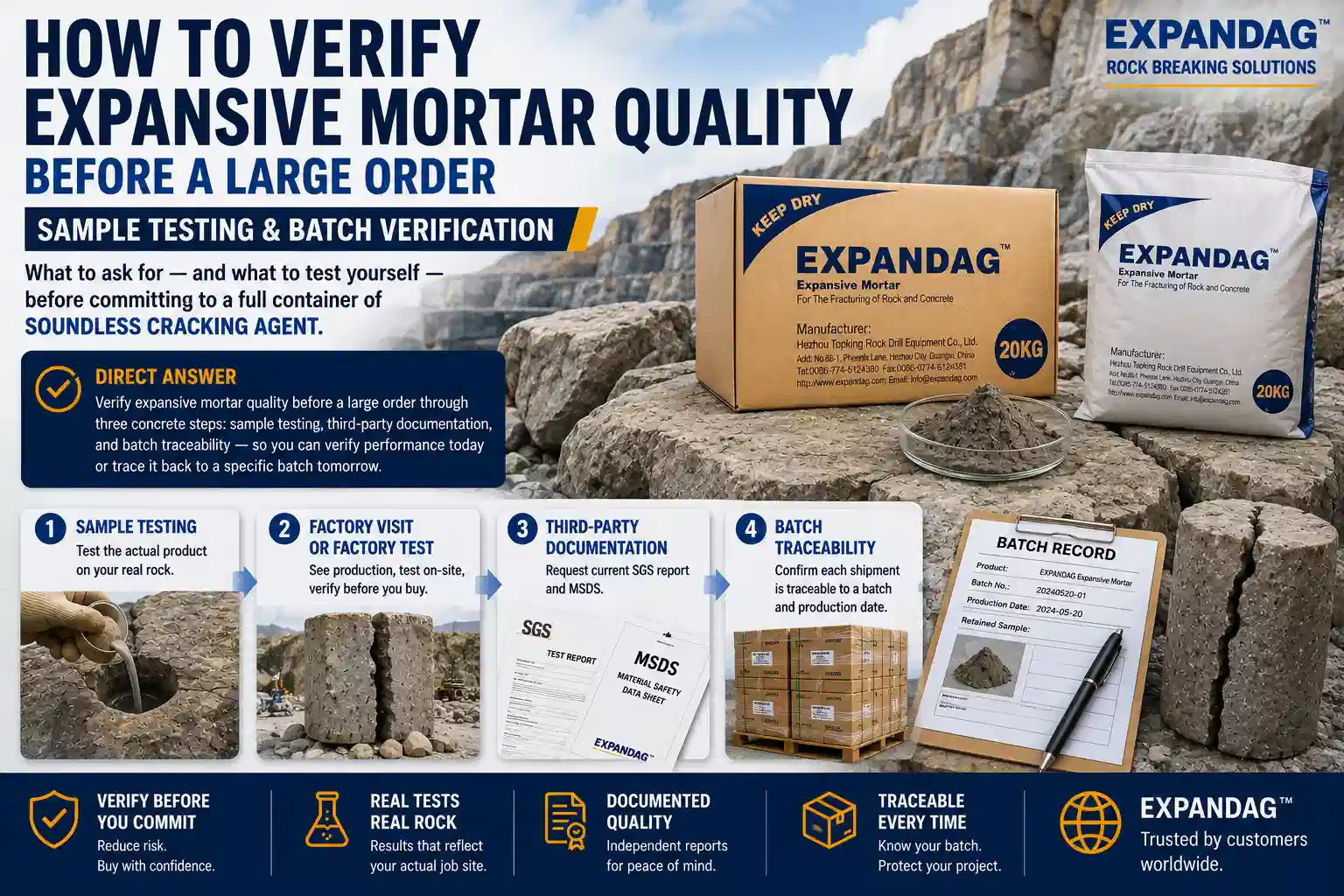
Verify expansive mortar quality before a large order through three concrete steps: request a small sample shipment and test it yourself on the actual rock type intended for the project, request the supplier's current SGS third-party test report and MSDS, and confirm the supplier retains a batch sample from every shipment traceable back to a production date. None of these require trusting a spec sheet on its own — they let a buyer verify performance directly, or at minimum trace a problem back to a specific batch if one occurs later. EXPANDAG ships sample cartons to prospective buyers on request, and welcomes customers to visit the Hezhou factory directly to test product on-site before committing to a full order.
None of this is unusual or difficult to ask for. A supplier unwilling to provide a sample, a current SGS report, or basic batch traceability is telling a buyer something before the first order ever ships.
Step One: Request a Sample Before Ordering in Bulk
A sample shipment is the single most direct way to verify expansive mortar performance — it lets a buyer test the actual product, on the actual rock type intended for the project, before any large-quantity commitment. EXPANDAG regularly ships sample cartons to prospective buyers for exactly this reason; a recent example sent two cartons of sample product to a buyer in Singapore ahead of a larger order decision.
What to actually do with a sample once it arrives:
Test on the real rock type, not a convenient substitute. A sample that performs well on soft limestone doesn't confirm anything about how it will behave on granite, and vice versa.
Follow the standard mixing ratio and borehole spec exactly. A sample tested with the wrong water ratio or an undersized borehole isn't testing the product — it's testing an incorrect procedure, and the result won't reflect real performance.
Time the crack initiation. Compare against the supplier's stated benchmark for that product grade and ambient temperature, rather than a generic number pulled from unrelated sources.
Check expansion pressure indirectly through crack quality — a clean, complete split versus a partial or failed crack tells you more in practice than the MPa figure alone.
Step Two: Visit the Factory, or Ask for a Factory-Side Test
Sample testing on the buyer's own site is the most relevant test, but it isn't the only option — some buyers prefer, or are positioned, to verify product by visiting the factory directly. EXPANDAG customers from South Korea and Somalia have both visited the Hezhou factory in person specifically to test and verify product before finalizing an order, and the factory welcomes this kind of visit as standard practice, not a special accommodation.
A factory visit gives a buyer more than a performance test — it's a chance to see actual production conditions, packaging process, and quality control directly, rather than relying entirely on documentation and photos. For buyers making a first large commitment to a new supplier, particularly on an unfamiliar international purchase, this is often worth the trip even when a sample shipment would technically be enough to test performance.
Step Three: Request Third-Party Documentation — SGS and MSDS
Performance testing confirms the product works. Documentation confirms what's actually in it, and gives a buyer something concrete to reference if a dispute or customs question comes up later. EXPANDAG maintains SGS third-party test reports and current MSDS documentation, both of which should be standard requests from any buyer before a large order, not an unusual ask.
| Document | What It Confirms |
|---|---|
| SGS Test Report | Independent third-party test results for the properties covered by the report — providing verification beyond the manufacturer's own claims |
| MSDS (Safety Data Sheet) | Chemical composition and safety data, commonly requested for chemical-product import documentation and safe handling on-site |
A supplier that hesitates to provide a current SGS report, or offers one that's years out of date, is worth asking follow-up questions before proceeding — not necessarily a dealbreaker on its own, but a signal to verify further rather than assume.
Step Four: Confirm Batch Traceability Before You Need It
The most overlooked verification step isn't about the order about to be placed — it's about what happens if a problem shows up in a shipment months later. EXPANDAG retains a sample from every outbound shipment, so if a quality issue does arise, it can be traced back to that specific batch and production date rather than left as an unresolved guess about what went wrong or when.
Ask about batch traceability before the order ships, not after a problem shows up — a supplier that can't trace a shipment back to a production date has already made that question unanswerable by the time it actually matters.
This is a simple question to ask before ordering: does the supplier keep a retained sample per shipment, and can they trace a batch number back to a production date if needed? A clear "yes" with a described process is a stronger signal than a general assurance about quality.
Field Insight from EXPANDAG Engineers
The buyers who skip verification rarely regret it — until the one time something doesn't perform as expected on-site, and there's no sample test, no report, and no batch record to work from. A customer in Madagascar who tested and then ordered gave us direct feedback that the product performed well on their project — that kind of confirmation only exists because the verification step happened first, not because we said it would work. Buyers who build sample testing and documentation requests into their standard process aren't being difficult. They're doing the one thing that actually protects a large order before it's too late to matter.
Quick Technical Summary
Request a sample shipment and test it on the actual rock type intended for the project before ordering in bulk
Follow the standard mixing ratio and borehole specification exactly when testing — an incorrect procedure invalidates the test
Visiting the factory directly is a legitimate verification option, not just sample testing
Request current SGS third-party test reports and MSDS documentation as standard practice
Confirm batch traceability (retained samples, traceable production dates) before the order ships, not after a problem occurs
A supplier's willingness to provide samples, current reports, and traceability answers is itself a signal worth weighing
Quality Verification FAQ
Q: Can I Get a Sample of Expansive Mortar Before Placing a Large Order?
Yes — EXPANDAG regularly ships sample cartons to prospective buyers ahead of a larger order decision, including a recent shipment of two sample cartons to a buyer in Singapore. Testing a sample on the actual rock type intended for the project is the most direct way to verify performance before committing to bulk quantity.
Q: Can I Visit the Factory to Test Soundless Cracking Agent Before Ordering?
Yes. Customers from South Korea and Somalia have both visited EXPANDAG's Hezhou factory in person specifically to test and verify the product before finalizing orders, and factory visits for this purpose are welcomed as standard practice.
Q: What Documentation Should I Request to Verify Expansive Mortar Quality?
Request a current SGS third-party test report and MSDS documentation as standard practice before a large order. SGS provides independent verification of the product beyond the manufacturer's own claims, while MSDS documentation covers chemical composition and safety data needed for both handling and customs clearance.
Q: How Can I Trace a Quality Problem Back to a Specific Batch?
Ask the supplier whether they retain a sample from every outbound shipment traceable to a production date — EXPANDAG does this as standard practice, so if a quality issue arises, it can be traced back to the specific batch and production date rather than left unresolved. Confirm this process before ordering, not after a problem occurs.
Q: Why Do International Buyers Trust EXPANDAG's Quality Verification Process?
EXPANDAG supports verification at every stage a buyer might need it — sample shipments for on-site testing, factory visits for hands-on evaluation, current SGS and MSDS documentation, and per-shipment batch retention for traceability. This combination gives international buyers concrete ways to confirm quality before committing to a large order, rather than relying on claims alone.
Final Engineering Verdict
Verification isn't a formality to get through before an order — it's the part of the process that determines whether a large shipment is a calculated decision or a guess. Test a sample on the real rock, ask for current SGS and MSDS documentation, and confirm batch traceability before the order ships. Suppliers who make all three easy to get aren't doing a buyer a special favor — they're demonstrating that the product holds up to the same scrutiny before the order as after it.
Request a Sample