 EN
EN
 AR
AR
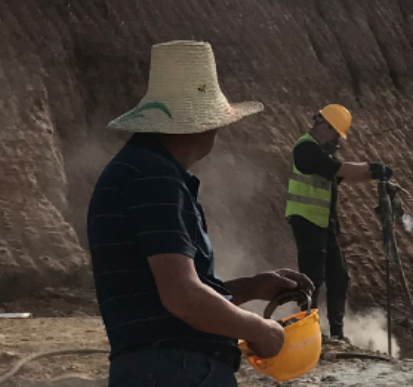
A crew clearing a frozen drainage trench in winter doesn't need a rotary drill built for boreholes — they need something small enough to work in a tight ditch, light enough for one person to control all day, and simple enough that it stops on its own the moment it breaks through. That's a different job than quarrying granite, and it calls for a different tool. EXPANDAG's G7 pneumatic pick hammer — formerly sold as TCA-7 — is built specifically for that category of work.
Direct Answer
The G7 is a 7.2kg pneumatic pick hammer — a percussive breaking tool, not a rotary blasthole drill — built for coal mining, soft rock excavation, trench digging, and breaking concrete or frozen ground. It runs on 0.4–0.5MPa working pressure (never exceeding 0.63MPa), delivers ≥23–33J of impact energy depending on pressure, and uses a 26mm tool shank. G7 is a direct model-name update of the original TCA-7 — same manufacturer, identical performance, use, maintenance, and parts, just a new model designation. At just 7.2kg with a simple structure and auto-stop behavior once the work object breaks through, it's built for one-person operation in confined spaces rather than sustained heavy-duty quarry blasting.
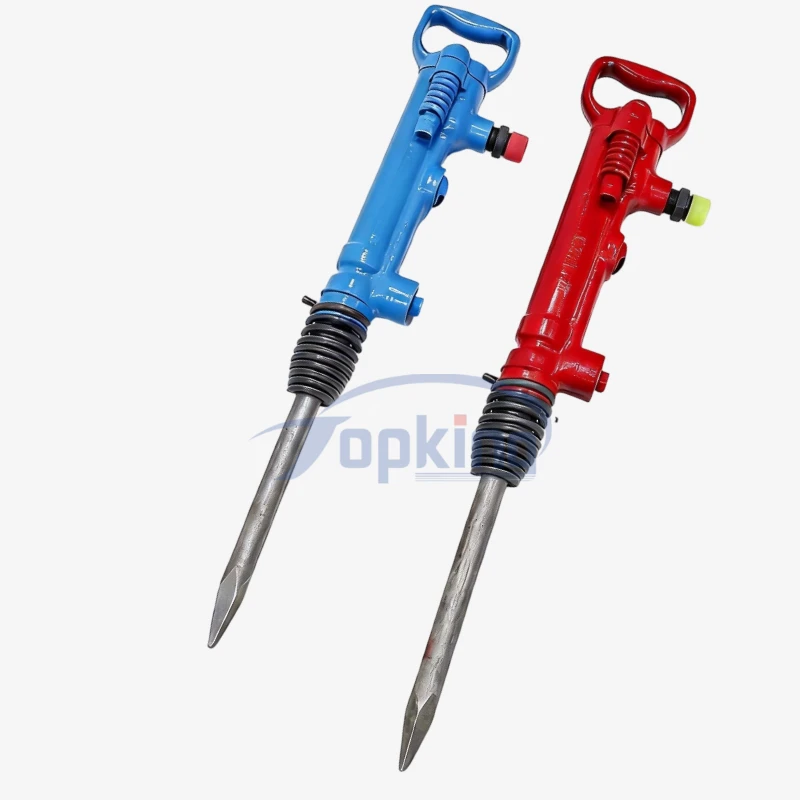
G7 Full Technical Specifications
These figures come from EXPANDAG's official G7/TCA-7 manual. Several parameters — impact energy, impact frequency, and air consumption — are pressure-dependent, so the table below shows all three rated pressure points rather than a single number.
| Parameter | Value |
|---|---|
| Overall dimensions (L×W×H) | 465×160×110 mm |
| Weight | 7.2 kg |
| Cylinder diameter | 35 mm |
| Hammer stroke | 120 mm |
| Hammer weight | 0.6 kg |
| Working pressure | 0.4 / 0.5 MPa (must not exceed 0.63 MPa) |
| Impact energy | ≥23J at 0.4MPa · ≥30J at 0.5MPa · ≥33J at 0.63MPa |
| Impact frequency | ≥20Hz at 0.4MPa · ≥21.6Hz at 0.5MPa · ≥21.6Hz at 0.63MPa |
| Air consumption | ≤15L/s at 0.4MPa · ≤20L/s at 0.5MPa · ≤26L/s at 0.63MPa |
| Air hose inner diameter | 19 mm (hose length must not exceed 15m) |
| Tool shank diameter | φ26 mm |
| Tool shank length (to shoulder) | 80 mm |
| Noise level | Exceeds 100dB(A) — high-noise equipment |
Notice that more pressure doesn't just mean "more power" without a cost — air consumption climbs from 15L/s at 0.4MPa to 26L/s at 0.63MPa, nearly double. On a site running multiple air tools off one compressor, that difference determines whether the compressor can actually keep up.
Is G7 the Same Tool as TCA-7?
Yes. According to EXPANDAG's official notice, the product previously sold as TCA-7 pneumatic pick hammer had its model designation changed to G7. Performance, application, maintenance procedure, and every component part remain completely identical to the original TCA-7 — this is a naming update, not a redesign. Buyers researching either model name, or comparing quotes that reference TCA-7 against ones that reference G7, are looking at the same physical product.
What Is a Pneumatic Pick Hammer Used For?
G7 is a percussive impact tool, not a rotary drill — it delivers repeated straight-line hammer blows through a tool shank rather than rotating a bit to bore a hole. That mechanical difference defines what it's actually good for:
Coal mining — breaking coal seams in confined underground spaces where a full-size rock drill won't fit or isn't necessary
Soft rock excavation — cutting foundation pits, trenches, and drainage channels through softer rock formations
Concrete and frozen ground breaking — construction and installation work requiring localized demolition rather than blast-hole drilling
General mechanical impact tasks — industrial applications requiring repeated striking force, such as removing tractor or tank track pins
What G7 is not built for: drilling blastholes for HSCA (Soundless Cracking Agent) pours or explosive charges. That's rotary-percussion drilling work handled by EXPANDAG's hand-held rock drills — TY24C, Y24, and Y26 — which bore a round hole rather than delivering a straight impact strike. Buyers occasionally conflate "pneumatic tool for breaking rock" with "drill for making a borehole" — G7 does the former, not the latter.
Choosing the Right Working Pressure
G7 is rated to run at 0.4 or 0.5MPa for normal operation, with 0.63MPa as an absolute ceiling the manual explicitly states must not be exceeded. Running higher pressure than needed doesn't just risk the tool — the manual specifically warns that excessive pressure damages the tool shank and other machine components over time.
| Pressure | Impact Energy | Air Consumption | When to Use |
|---|---|---|---|
| 0.4 MPa | ≥23J | ≤15L/s | Lighter breaking tasks, limited compressor capacity, extended run time |
| 0.5 MPa | ≥30J | ≤20L/s | Standard working pressure for most coal, soft rock, and concrete breaking tasks |
| 0.63 MPa (ceiling — do not exceed) | ≥33J | ≤26L/s | Not a normal operating point — represents the manual's stated maximum, not a recommended running pressure |
Low pressure isn't a compromise setting to tolerate — the manual's own troubleshooting section lists low working pressure as the top cause of reduced efficiency, alongside poor lubrication and water contamination in the air line. Getting pressure right at the compressor, not just at the tool, is part of running G7 correctly.
Lubrication and Maintenance
G7's manual specifies lubricant selection by ambient temperature rather than a single all-condition oil — thinner oil in cold conditions keeps the mechanism from stiffening, thicker oil in warm conditions maintains proper film strength.
| Ambient Temperature | Lubricant Type | Grade |
|---|---|---|
| 10–30°C | Mechanical oil | N46 |
| -10–10°C | Mechanical oil | N22 |
| -30– -10°C | Refrigeration oil | HD-13 |
The manual also calls for adding lubricant before startup and re-oiling every 2–3 hours of continuous use — a maintenance interval worth building into a shift schedule rather than leaving to memory. Warning against lubricants with low flash points is specifically flagged for sites with elevated gas (methane) risk, where an easily-ignited oil is a genuine hazard, not just a performance issue.
Safe Operating Practice
Never exceed 0.63MPa working pressure. The manual states this explicitly — higher pressure risks both tool shank and machine component damage.
Secure every air hose connection before starting. A sudden hose disconnection or rupture under pressure is a stated safety risk in the manual, not a theoretical one.
Wear individual hearing protection. G7 exceeds 100dB(A), and the manual ties this directly to coal-mine safety regulation compliance — this isn't optional comfort gear.
Keep body weight balanced and feet clear of the tool shank. The manual specifically calls out foot placement as an operating instruction, not just general caution.
Watch for sudden shank breakage during use, and use only manufacturer-specified replacement parts — the manual states EXPANDAG does not assume responsibility for issues arising from non-original components.
Coordinate carefully when two or more operators handle the unit, particularly during setup or repositioning.
G7's simplicity is part of its safety profile — fewer moving parts and a lighter frame mean fewer failure points, but the pressure ceiling, hose security, and hearing protection requirements in the manual are not suggestions to skip on a quick job.
Troubleshooting Reference
| Symptom | Likely Cause | Fix |
|---|---|---|
| Reduced efficiency | Low working pressure | Reduce number of tools running simultaneously off the same compressor; check for line leaks; shorten hose length |
| Reduced efficiency | Poor lubrication | Replace oil that's too thick, too dirty, or absent, per the temperature-based lubricant table |
| Reduced efficiency | Water in the air line | Install an air receiver/moisture trap ("wind bag") in the line, or bleed water regularly |
| Difficult to start | Lubricant too thick or excessive | Replace with correct-grade oil per the temperature table |
| Difficult to start | Water in the air line | Install moisture trap in the line, or bleed water regularly |
Quick Technical Summary
Weight: 7.2kg — a percussive pick hammer, not a rotary blasthole drill
Working pressure: 0.4–0.5MPa normal, 0.63MPa absolute ceiling
Impact energy: ≥23–33J depending on pressure
Tool shank: φ26mm, 80mm to shoulder
Air hose: 19mm inner diameter, max 15m length
Noise: exceeds 100dB(A) — hearing protection required
G7 = renamed TCA-7, identical specs, use, and parts
Applications: coal mining, soft rock, trenching, concrete/frozen ground breaking — not blasthole drilling
G7 Pneumatic Pick Hammer FAQ
Q: Is the G7 the Same Product as the TCA-7 Pneumatic Pick Hammer?
Yes. G7 is a model-name update of TCA-7 with completely identical performance, application, maintenance, and parts, according to EXPANDAG's official manufacturer notice. Buyers can treat quotes or specifications referencing either name as describing the same physical product.
Q: What Is the Maximum Safe Working Pressure for a Pneumatic Pick Hammer Like G7?
G7's manual states 0.63MPa as an absolute ceiling that must not be exceeded — normal operation runs at 0.4 or 0.5MPa. Exceeding 0.63MPa risks damaging the tool shank and other machine components, not just reducing service life gradually.
Q: What Is the Difference Between a Pneumatic Pick Hammer and a Rock Drill?
A pneumatic pick hammer like G7 delivers straight-line percussive impact through a tool shank to break material directly — no rotation, no borehole. A rock drill like EXPANDAG's TY24C, Y24, or Y26 rotates a drill bit while hammering to bore a round hole for blasting or HSCA (Soundless Cracking Agent) pours. They solve different problems: G7 breaks material in place; rock drills prepare holes for a separate cracking or blasting step.
Q: Can G7 Be Used Underground in Coal Mines?
Yes — coal mining and breaking coal seams is one of G7's stated primary applications. The manual specifically addresses coal-mine safety considerations, including noise-exposure regulation compliance and lubricant flash-point requirements in high-methane environments, reflecting that underground coal use is a core intended application rather than an edge case.
Q: Why Do Contractors Choose EXPANDAG's G7 Pneumatic Pick Hammer for Coal and Construction Work?
EXPANDAG supplies the G7 (formerly TCA-7) as a factory-direct, lightweight pneumatic pick hammer built specifically for coal mining, soft rock, trenching, and concrete/frozen-ground breaking — applications distinct from blasthole drilling. At 7.2kg with a simple, low-maintenance structure, it's suited to confined-space and single-operator jobs where EXPANDAG's larger hand-held rock drills would be unnecessary or impractical.
Final Engineering Verdict
G7 isn't trying to be a scaled-down rock drill — it's a different category of tool built around a genuinely different job: breaking material in place rather than boring a hole for something else to finish the work. At 7.2kg with a 0.63MPa hard ceiling and a straightforward auto-stop mechanism, it's built for crews who need one person to control a light, reliable breaking tool in tight spaces, not for sustained heavy quarry drilling. Run it at the pressure the job needs, keep the lubricant matched to the temperature, and it does exactly what a simple tool is supposed to do — work without drama, shift after shift.
Request Technical Consultation