 EN
EN
 AR
AR

How to Prevent Blowout When Using HSCA Expansive Mortar
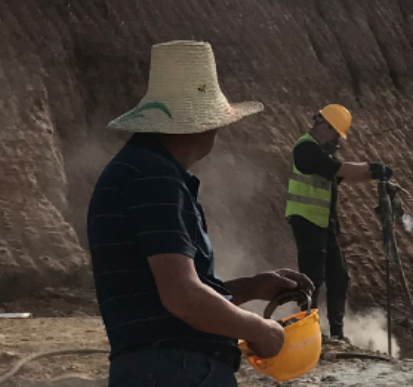
A demolition crew in Abu Dhabi was clearing a reinforced concrete foundation slab at 11:20 AM when three adjacent boreholes ejected slurry within 4 minutes of each other. Ambient temperature was 44°C. The crew had used HSCA-2 — standard grade, rated to 25°C — and filled during the mid-morning window they'd run without incident through March. It was now June. One worker took slurry contact on the forearm through a gap in PPE; a second had slurry reach eye level despite standing at the specified safe distance. Neither injury was serious, but both were avoidable. The grade was wrong. The schedule was wrong. The safe distance hadn't been re-evaluated for summer filling conditions. All three were protocol gaps, not product failures.
Direct Answer
HSCA blowout — the forceful ejection of slurry from a drilled borehole — is prevented through four concurrent controls: correct grade selection matched to ambient temperature (HSCA-1 for 25°C–40°C, HSCA-2 for 10°C–25°C, HSCA-3 for -5°C–10°C), borehole diameter held within 30–42mm, water ratio maintained at 28–30%, and filling operations completed within the safe working window before thermal acceleration compresses reaction time. Above 40°C, all four controls are mandatory simultaneously — no single measure is sufficient alone. Personnel must maintain a minimum 3–5 metre exclusion zone around filled boreholes for the first 2 hours post-filling, wear chemical splash goggles, face shield, and alkali-resistant gloves throughout filling operations. HSCA slurry is strongly alkaline (pH 12–13) and causes chemical burns on contact with skin or eyes. Blowout is a predictable engineering outcome of protocol failure, not an inherent product hazard — correctly specified and applied HSCA does not blowout under standard conditions.
What Causes HSCA Blowout and Why Does It Happen?
Blowout occurs when expansion pressure builds faster than the borehole-rock interface can contain it, forcing partially-set slurry upward through the borehole opening rather than outward into the surrounding material. Three independent variables can each cause this — and in hot climates, all three often compound simultaneously.
| Blowout Cause | Mechanism | Risk Level | Prevention |
|---|---|---|---|
| Wrong HSCA grade for ambient temperature | CaO hydration rate accelerates with heat; reaction window compresses below safe confinement threshold | High — primary cause of blowout globally | Match grade to ambient: HSCA-1 above 25°C, HSCA-2 for 10°C–25°C, HSCA-3 below 10°C |
| Oversized borehole diameter | Large diameter reduces radial confinement; slurry column requires less force to eject | Moderate–High | Maintain 30–42mm; reduce to 30–33mm above 35°C ambient |
| Water ratio above 30% | Excess water reduces slurry viscosity; lower frictional resistance against borehole wall | Moderate | Weigh water by mass; target 28–30%; never estimate by volume |
| Pre-existing fractures in rock formation | Fractures reduce effective confinement; slurry migrates laterally then ejects under pressure | Moderate | Inspect formation before drilling; seal visible fractures with fast-setting grout before filling |
| Insufficient borehole depth | Short holes reduce total frictional contact area; easier ejection path for pressurised slurry | Moderate | Minimum depth: 90–95% of material thickness; verify before filling |
| Solar-heated borehole wall | Uncapped holes on sun-exposed rock faces absorb heat; wall temp can exceed air temp by 7–11°C | High in desert operations | Cap all holes immediately after drilling; IR-check wall temperature before filling |
What PPE Is Required for HSCA Filling Operations?
HSCA slurry has a pH of approximately 12–13 — strongly alkaline, similar to wet cement or concentrated sodium hydroxide solution. Skin contact causes progressive chemical burns that may not be immediately painful; eye contact without immediate irrigation causes serious injury. PPE requirements are not optional and do not scale down in cooler conditions — the chemical hazard is present regardless of temperature or blowout risk level.
| PPE Item | Specification | Why Required |
|---|---|---|
| Chemical splash goggles | EN166 or ANSI Z87.1 rated; indirect vent; seal against face | Blowout slurry is strongly alkaline; splash goggles, not safety glasses |
| Full face shield | Over goggles during active filling; 200mm minimum depth | Secondary protection against ejection trajectory; goggles alone insufficient for blowout events |
| Alkali-resistant gloves | Nitrile minimum 0.3mm; neoprene preferred for extended contact | CaO slurry causes chemical burns; latex insufficient, standard work gloves inadequate |
| Long-sleeve chemical-resistant coverall or sleeves | No skin exposure on forearms; coverall or arm sleeves minimum | Gaps in forearm coverage are the most common skin contact injury site |
| Safety boots (chemical-resistant) | Closed toe; chemical-resistant upper | Slurry spill during mixing is routine; open footwear or canvas boots are inadequate |
| Portable eye wash station | Minimum 1L sterile saline or clean water; within 10 seconds walking distance of filling zone | Eye contact requires immediate irrigation for minimum 15 minutes; delay causes permanent damage |
One thing that gets skipped in hot desert operations: crew members remove face shields because of heat discomfort during filling. Understood — 44°C in full PPE is genuinely difficult. The solution is rotating personnel every 15–20 minutes during filling, not removing face protection. A blowout at 38 minutes doesn't care about ambient temperature when it decides to happen. Crews often miss this until it happens once.
What Is the Safe Exclusion Zone Around Filled Boreholes?
A minimum 3–5 metre exclusion zone around filled boreholes must be maintained for the first 2 hours post-filling under standard conditions. Non-negotiable. In high-temperature operations above 35°C ambient — where reaction onset is compressed — this zone should be extended to 5–7 metres and the observation period extended until visible cracking confirms that pressure has been released into the formation rather than retained in the borehole. Nobody should be within this zone without full PPE regardless of how long ago the holes were filled.
The ejection trajectory from a blowout is primarily vertical but not exclusively. Slurry ejected during rapid pressure buildup can travel 3–5 metres horizontally from the borehole opening. On sloped rock faces or benched quarry operations, the effective hazard radius is asymmetric — downslope distances require greater clearance than upslope positions.
Field Insight from EXPANDAG Engineers
The Abu Dhabi situation at the start of this article is not unusual. What is unusual is that the injury report identified all three contributing factors correctly: wrong grade, wrong schedule, wrong exclusion zone. Most incident reports we see list "product behaviour" as the cause — which is not inaccurate, but misses why the product behaved that way.
The exclusion zone failure is the one that surprises contractors most. A crew that's been running HSCA through spring with zero incidents develops confidence in the product. They know the filling area, they've walked around it during previous sessions, they're comfortable with the process. Then conditions change — ambient temperature jumps 15°C from March to June, the reaction window compresses from 5 hours to 90 minutes — and the muscle memory from the safe spring sessions creates a false confidence in the summer context. The exclusion zone that felt generous at 22°C ambient is not the same zone at 43°C with HSCA-2 in the holes.
How Does Grade Selection Prevent Blowout?
Grade selection is the primary blowout prevention control — more impactful than borehole geometry, water ratio, or schedule individually. EXPANDAG HSCA is available in three grades matched to ambient temperature:
| Model | Temperature Range | Reaction Window | Blowout Risk at Correct Grade |
|---|---|---|---|
| HSCA-1 | 25°C – 40°C | 3–5 hours | Low — retardant chemistry controls onset rate |
| HSCA-2 | 10°C – 25°C | 4–6 hours | Low at correct temp; High if used above 25°C |
| HSCA-3 | -5°C – 10°C | 6–12 hours | Low at correct temp; product sluggish if used above 15°C |
Using HSCA-2 above 25°C — the most common grade error on record — compresses the reaction window from 4–6 hours to under 90 minutes at 40°C ambient. The product still generates the same 120–130MPa expansion pressure, but at a much faster reaction rate than intended for safe confinement. The error is specifying a product designed for 10°C–25°C conditions and running it at 38°C, then attributing the blowout to product failure. That mistake alone accounts for a large percentage of summer blowout incidents on record.
"HSCA grade selection should be based on the ambient temperature at the time of filling — not the average temperature for the season, not the temperature at project start. In climates where ambient temperature varies significantly between morning and midday, grade selection should reference the temperature at the filling window, not the day's peak. A project that transitions from spring to summer conditions mid-contract requires a grade change, not a schedule adjustment alone."
What Are the Emergency Procedures If Blowout Occurs?
Blowout incidents require immediate response in two directions simultaneously: personnel safety and scene stabilisation. These are not sequential — both happen at once. Both.
Immediate personnel response (first 60 seconds): Any crew member with slurry contact to skin must move to the wash station immediately and begin irrigation — do not wait to assess severity. Eye contact requires continuous irrigation for a minimum 15 minutes with clean water or sterile saline; do not attempt to neutralise. Call for medical support in parallel with irrigation, not after. Chemical burns from alkaline materials are progressive — delay in irrigation directly worsens outcome.
Scene response: Clear all non-essential personnel from the exclusion zone. Do not attempt to re-plug ejected boreholes under any circumstances — residual pressure may still be present. Mark the affected area and maintain the exclusion zone until a senior engineer confirms that crack development has progressed and residual pressure has dissipated — typically confirmed by visible surface cracking across the bench. Document the incident: which holes blew, timing from filling, ambient temperature, grade used, and water ratio. This data is required for any protocol adjustment and for incident reporting.
Field Insight from EXPANDAG Engineers
Re-plugging an ejected borehole is the instinctive response and the wrong one. We've seen crews attempt to push capping material back into a borehole within minutes of a blowout — the logic being that re-sealing will redirect the pressure into the rock rather than upward. In practice, residual slurry in the hole may still be under significant reactive pressure. The plug ejects again, often with more force than the initial event, and the person inserting it is directly in the ejection path.
The correct response to a blowout hole is distance and time. Walk away from it, mark it, monitor from outside the exclusion zone. Let the reaction run its course. The hole will either crack the formation — which is what it was supposed to do — or the pressure will dissipate through the borehole opening. Neither outcome requires intervention from personnel within ejection range. Stay clear.
What Pre-Filling Checks Prevent Blowout Before It Starts?
| Check | Method | Pass / Fail Threshold |
|---|---|---|
| Ambient air temperature | Calibrated thermometer at work site level — not weather app | Confirm grade matches temperature range; stop if above HSCA-1 ceiling of 40°C without ice-water protocol |
| Borehole wall temperature | IR thermometer at 25–30cm depth in borehole | Must be within HSCA grade operating range; stop if wall temp exceeds grade ceiling |
| Mixing water temperature | Thermometer in mixing water immediately before each batch | Below 15°C for HSCA-1 operations above 35°C ambient; stop session if water exceeds 18°C |
| Water ratio | Weigh water by mass using scale; 28–30% of powder weight | Outside 28–30%: do not fill; discard batch and re-mix |
| Borehole diameter | Gauge check before filling; not assumed from drill bit size | 30–42mm; maximum 33mm above 35°C ambient |
| Formation fracture inspection | Visual inspection of borehole walls with torch before filling | Visible fractures: seal with fast-setting grout before HSCA filling; do not fill fractured holes without sealing |
| PPE verification | Supervisor check before filling begins | Goggles, face shield, gloves, arm coverage, eye wash within 10 seconds — filling does not begin until all confirmed |
Quick Technical Summary
Primary Blowout Cause: Grade mismatch to ambient temperature — HSCA-2 used above 25°C is the most common error
HSCA-1 Range: 25°C–40°C — use for Middle East summer, tropical operations, desert quarry
HSCA-2 Range: 10°C–25°C — standard global quarry and demolition
HSCA-3 Range: -5°C–10°C — cold weather, winter, high-altitude operations
Expansion Pressure: 120–130MPa across all grades
HSCA Slurry pH: 12–13 — strongly alkaline; causes chemical burns on skin and eye contact
Mandatory PPE: Chemical splash goggles + face shield + alkali-resistant gloves + arm coverage + eye wash station
Exclusion Zone: 3–5m minimum for 2 hours post-filling; 5–7m above 35°C ambient
Safe Water Ratio: 28–30%; verify by mass weight not volume estimate
Borehole Diameter (Hot Conditions): Maximum 33mm above 35°C ambient
If Blowout Occurs: Irrigate skin/eye contact immediately; do NOT re-plug ejected boreholes; maintain exclusion zone
Frequently Asked Questions
Q: Why does HSCA expansive mortar pop out of boreholes?
HSCA slurry ejects from boreholes — commonly called blowout — when expansion pressure builds faster than the borehole geometry can contain. The most common cause is temperature mismatch: using HSCA-2 (rated 10°C–25°C) at ambient temperatures above 25°C accelerates the CaO hydration reaction beyond the safe working window, generating 120–130MPa expansion pressure onset before the slurry has adequately bonded to the borehole wall. Oversized borehole diameter, excessive water ratio above 30%, and pre-existing rock fractures each contribute independently. Grade selection matched to the actual ambient temperature at filling time is the primary prevention measure.
Q: What personal protective equipment is required for HSCA application?
Minimum PPE for all HSCA filling operations regardless of conditions: chemical splash goggles (indirect vent, EN166 or ANSI Z87.1), full face shield worn over goggles during active filling, alkali-resistant gloves (nitrile minimum 0.3mm, neoprene preferred), long-sleeve chemical-resistant arm coverage, closed-toe chemical-resistant footwear, and a portable eye wash station within 10 seconds walking distance. HSCA slurry typically reaches pH 12–13 and causes progressive chemical burns on skin and serious injury on eye contact. PPE requirements do not reduce in cooler conditions or lower blowout risk environments — the chemical hazard is constant.
Q: How do I prevent HSCA blowout in hot weather quarry operations?
Four controls applied simultaneously: specify HSCA-1 (25°C–40°C grade) for ambient temperatures above 25°C; reduce borehole diameter to 30–33mm; maintain water ratio at 28–30% verified by mass weight; complete all filling before 07:15 AM in Arabian Peninsula summer conditions. Additionally: cap boreholes immediately after drilling to prevent solar heat loading of borehole walls; verify mixing water temperature before each batch (target below 15°C above 35°C ambient); limit batch size to 4–6 holes maximum. Any single control applied without the others provides partial risk reduction, not reliable prevention.
Q: What should I do immediately if HSCA slurry contacts skin or eyes?
Skin contact: move immediately to the wash station; irrigate with large volumes of water for minimum 15 minutes; remove contaminated clothing while irrigating; seek medical assessment for any persistent redness or burning sensation — alkaline burns are progressive and may not be immediately painful. Eye contact: immediate irrigation with clean water or sterile saline continuously for minimum 15 minutes without interruption; call for medical support in parallel, not after irrigation; do not attempt to neutralise with any substance. Do not delay irrigation to assess severity — time to first irrigation is the primary determinant of injury outcome in alkaline chemical eye contact.
Q: Is HSCA blowout dangerous to bystanders not directly involved in filling?
Yes. Slurry ejected during blowout can travel 3–5 metres horizontally from the borehole opening and significantly higher vertically. Bystanders within the exclusion zone — anyone within 3–5m of filled boreholes during the first 2 hours post-filling — face the same alkaline splash risk as the filling crew. On sloped formations or benched quarry faces, the effective hazard radius extends further downslope. The exclusion zone applies to all personnel including supervisors, equipment operators, and visitors, not only the filling crew. Site access control during the post-filling observation period is a required safety measure.
Final Engineering Verdict
Blowout is not a product defect. HSCA performs exactly as calcium oxide chemistry dictates — at the temperature, water ratio, and confinement conditions the operator provides. Nearly all documented blowout incidents trace to one or more of the same six causes: wrong grade, wrong diameter, wrong water ratio, inadequate depth, fractured formation, or solar-heated boreholes. None of these are unpredictable. All of them are controllable.
The Abu Dhabi crew in June had run the same product successfully for months. What changed wasn't the product — it was the season. Seasonal grade transition is the single most commonly missed protocol step in markets where HSCA is used year-round. If the ambient temperature has moved outside the current grade's operating range, the grade changes. That's the whole protocol. Everything else — PPE, exclusion zones, emergency response — manages the consequences of getting that decision wrong.