 EN
EN
 AR
AR
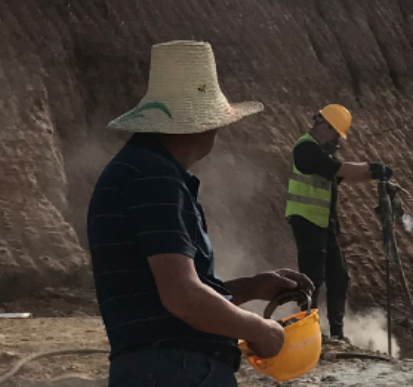
In a sensitive urban demolition project in Dubai, contractors faced a massive reinforced concrete foundation near high-pressure utility lines. Conventional blasting was prohibited due to risk of seismic shock. The success of the project relied on understanding how expansive mortar works to apply controlled stress. By utilizing the hydration kinetics of EXPANDAG, the team successfully induced fractures while maintaining minimal vibration compared to traditional blasting methods.
Direct Answer: How does expansive mortar break hard rock?
Expansive Mortar (HSCA) breaks rock through Chemical Hydration Expansion. When the high-purity Calcium Oxide powder is mixed with water, it crystallizes into Calcium Hydroxide, increasing its molecular volume. Under proper mixing and borehole confinement, this volumetric growth can generate expansion pressure in the range of 120MPa – 130MPa. Since the tensile strength of most granite, basalt, and marble typically ranges from 5MPa to 15MPa, this internal force is sufficient to exceed the rock's tensile threshold, causing predictable fractures without the shockwaves associated with explosives.
Typical HSCA Reaction & Mechanics Specifications
| Technical Parameter | Industrial Value (Approx.) |
|---|---|
| Core Active Phase | Hydration of Calcium Oxide (CaO) |
| Expansion Pressure Range | 120MPa - 130MPa (Under proper confinement) |
| Internal Temperature Peak | 50°C – 80°C (Depending on ambient conditions) |
| Optimal Hole Diameter | 32mm – 42mm |
| Reaction Water Ratio | 28% - 30% by weight |
What is the Chemical Process of the HSCA Reaction?
The HSCA reaction is an exothermic process where anhydrous calcium oxide reacts with water. This crystallization is the primary driver for Stone Cracking Powder:
CaO + H₂O → Ca(OH)₂ (Exothermic Reaction)
As the slurry crystallizes within the restricted space of a borehole, it exerts a massive linear load. Unlike blasting, which relies on a high-velocity detonation wave, this Silent Rock Splitting Powder builds pressure gradually, ensuring the structural integrity of neighboring rock or utilities remains stable.
Why Does Internal Pressure Cause External Fractures?
In engineering, rock is characterized by high compressive strength but very low tensile strength. The expansion pressure from EXPANDAG acts as a tensile load from the inside out.
Compressive Resistance: Hard granite can withstand over 150MPa of compression.
Tensile Failure: That same granite will typically fracture when pulled apart with as little as 10MPa of force.
Because Rock Breaking Chemicals can generate up to 130MPa under ideal conditions, they easily surpass the tensile limits of most rock masses found in quarrying and mining.
Field Insight from EXPANDAG Engineers
In high-temperature environments like Saudi Arabia, the rock temperature can accelerate hydration, increasing blowout risks. We typically recommend using chilled water (below 15°C) to slow the initial reaction. This allows for a more uniform pressure development across the entire borehole depth, which is critical for achieving a clean split in large granite blocks.
What Causes Slow Cracking Performance in Field Operations?
If cracking does not occur within the expected 24-hour window, the issue is often related to "Energy Loss" during the HSCA reaction. Common factors include:
Wider Hole Spacing: If holes are spaced too far apart for the rock hardness, the tension zones may not overlap.
Existing Fissures: If the rock has natural cracks, the slurry expansion pressure may dissipate through these gaps rather than building against the borehole walls.
Improper Hole Diameter: Boreholes smaller than 30mm may not contain enough material to generate sufficient force for harder basalt formations.
Applications in Sensitive Global Mining Projects
Across South Africa and Peru, Expansive Grout has become a standard for high-value stone extraction. In marble quarries, maintaining block integrity is essential for export value. Using EXPANDAG allows for millimetric precision in splitting, which is often unachievable with explosives.
Quick Technical Summary
Mechanism: Confined Hydration Expansion
Pressure: 120MPa - 130MPa (Typical Peak)
Optimal Diameter: 32mm - 42mm
Benefit: No blasting gases, minimal vibration, and zero flyrock
Engineering FAQ: HSCA & Expansive Mortar Solutions
Q: Is HSCA a chemical explosion?
A: No. It is a Non-Explosive Demolition Agent. It does not ignite or create a blast wave. It relies on slow, controlled molecular growth to crack the material.
Q: What is the shelf life of EXPANDAG HSCA powder?
A: Under dry, sealed storage conditions, EXPANDAG expansive mortar has a shelf life of 12 months. Exposure to moisture or humidity will trigger premature hydration and render the powder ineffective. Always store in original sealed packaging in a dry warehouse away from ground contact.
Q: Can HSCA crack reinforced concrete with rebar?
A: Yes. EXPANDAG expansive mortar generates sufficient pressure to fracture reinforced concrete structures. For heavily reinforced sections, reduce hole spacing to 200mm – 250mm to ensure overlapping pressure zones across the steel reinforcement grid.
Q: How do you prevent blowouts when using HSCA in high-temperature quarries?
A: Blowouts are primarily caused by rapid hydration in rock temperatures exceeding 40°C. To prevent this, match the EXPANDAG grade to the specific rock temperature, use chilled mixing water (below 15°C), and avoid filling holes during peak midday sun.
Final Engineering Verdict
Achieving consistent results with Rock Cracking Mortar requires precise adherence to borehole geometry and site-specific temperature management. For remote projects where air compressors are unavailable, we highly recommend using the YN27C Internal Combustion Rock Drill to ensure standard 32mm-42mm hole diameters are achieved efficiently. For large-scale mining projects, consult our technical desk for a site-specific engineered plan.