 EN
EN
 AR
AR
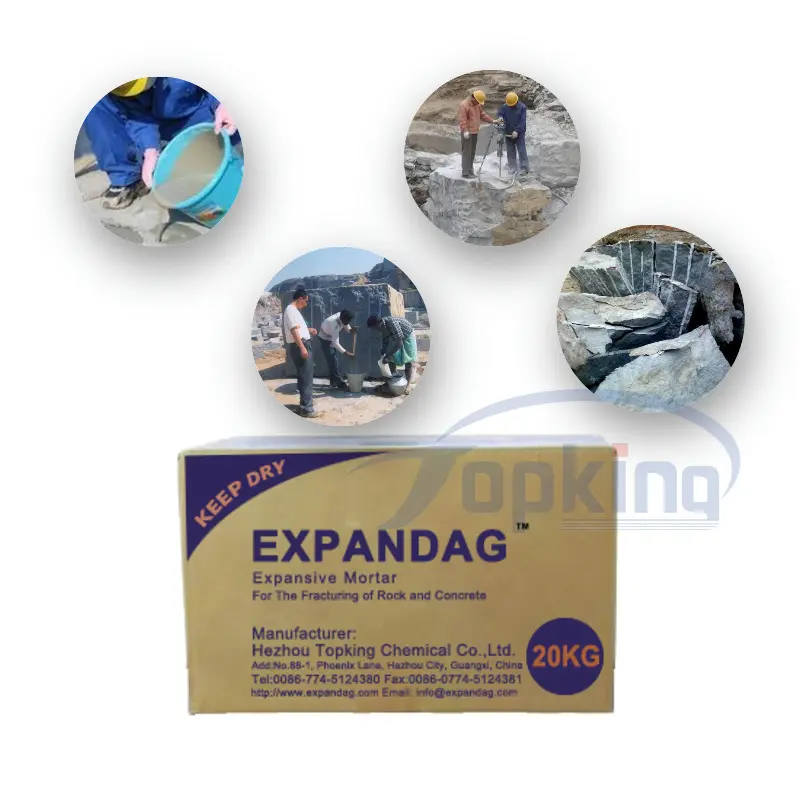
A quarry procurement manager in Oman recently contacted EXPANDAG after receiving wildly inconsistent quotes for what two suppliers both described as "expansive mortar." The difference was not fraud — it was a combination of grade mismatch, inaccurate packaging weight, undisclosed logistics costs, and one supplier quoting a branded Western equivalent rather than a direct-manufactured HSCA product. Understanding exactly what drives expansive mortar price per ton — and what variables are being hidden inside any given quote — is the difference between a profitable quarrying contract and a procurement miscalculation.
Direct Answer
The price of expansive mortar (HSCA / soundless cracking agent) per ton is not a fixed market rate — it is determined by at least six independent variables: temperature grade specification, order volume, supply chain position (factory direct vs. trader), packaging format, destination logistics, and CaO purity level. EXPANDAG HSCA generates 120–130 MPa of expansion pressure through calcium oxide hydration, with a 28–30% water-to-powder ratio and three professional temperature grades suited to environments from -5°C up to 40°C. We supply HSCA-3 for -5°C–10°C, HSCA-2 for 10°C–25°C, and HSCA-1 for 25°C–40°C. Grade selection, purity specification, and volume commitment are the three variables that most affect the quotation a contractor receives. Because pricing is project-specific and commercially sensitive, EXPANDAG provides verified wholesale quotations directly via WhatsApp consultation — not through published price lists.
What Factors Determine HSCA Expansive Mortar Price per Ton?
Expansive mortar cost per ton is the output of several independent variables that every procurement manager must evaluate before comparing quotes. Two suppliers quoting different figures for "soundless cracking agent" are almost never quoting the same product under the same conditions — even when the product name appears identical.
The primary cost drivers are: temperature grade specification, order volume and packaging format, supply chain position (manufacturer direct vs. trading company), destination freight and logistics structure, import duty classification in the destination country, and lead time urgency. Each of these factors can shift the effective per-ton cost significantly — and only a project-specific quotation from the manufacturer can produce an accurate number for any given situation.
| Cost Variable | Direction of Impact on Price | Notes |
|---|---|---|
| Temperature Grade (HSCA-1 / HSCA-2 / HSCA-3) | High-temperature HSCA-1 carries a slight premium over standard HSCA-2 | HSCA-1 for ambient temperatures up to 40°C adopts adjusted formulation for hot climate stability |
| Order Volume | Higher volume = lower per-ton cost; significant threshold at FCL container quantity | A 20-foot container holds approximately 20–22 metric tons of HSCA in 25kg bags |
| Supply Chain Position | Trading company markup adds substantial cost with no technical value added | Factory-direct procurement eliminates intermediary margin entirely |
| Packaging Format | Retail 25kg bags cost more per ton than 1,000kg FIBC bulk bags | Large projects should specify FIBC to reduce both packaging cost and on-site handling |
| Ocean Freight & Destination Logistics | Adds materially to landed cost; varies by destination region and freight market conditions | Always calculate landed cost, not just FOB; request CIF quotation when comparing suppliers |
| Import Duties & Customs Classification | Varies by destination country; HS code classification affects applicable tariff rate | EXPANDAG can advise on standard HS code classification for HSCA imports |
| Lead Time / Production Urgency | Rush orders and air freight carry significant surcharges over standard sea shipment | Standard sea lead time from China: 18–35 days depending on destination port |
Why Does HSCA Price Vary So Much Between Suppliers?
The wide variance in expansive mortar quotes from different suppliers is the most confusing aspect of HSCA procurement. Suppliers quoting the same product name at very different prices are almost never offering equivalent material — and the difference is usually not visible on a price comparison spreadsheet.
The core reasons for price variance are supply chain position, CaO purity specification, and grade accuracy. Trading companies operating between manufacturers and end buyers add margin with no corresponding technical value. A product priced attractively through a trader may originate from a low-specification manufacturer using calcium oxide with insufficient purity — producing HSCA that generates only 80–95 MPa of expansion pressure rather than the 120–130 MPa required for consistent crack initiation in hard granite or basalt.
CaO purity is the single most important quality indicator in HSCA. High-quality expansive mortar uses calcium oxide with ≥90% CaO content and controlled particle size distribution to ensure reliable hydration kinetics and full pressure development within 4–8 hours under standard conditions. Low-purity product may react incompletely, produce insufficient pressure, or exhibit unpredictable crack timing. None of this shows up in a price comparison — only in field performance. A "cheaper" quote that delivers underperforming product forces re-drilling and re-filling, multiplying actual material cost per cubic meter broken.
How Does Temperature Grade Selection Affect HSCA Cost and Performance?
Temperature grade is simultaneously the most important technical specification and one of the most overlooked cost variables in HSCA procurement. Ordering the wrong grade costs far more than paying a premium for the correct one — because mismatched grade either fails to crack the target material or causes dangerous blowout under high-temperature conditions.
| HSCA Grade | Ambient Temperature Range | Typical Application | Relative Cost vs. HSCA-2 |
|---|---|---|---|
| HSCA-3 | -5°C – 10°C | Cold climate operations; winter quarrying; high-altitude projects | Moderate premium |
| HSCA-2 | 10°C – 25°C | Standard grade; most widely produced; temperate climate general use | Base reference grade |
| HSCA-1 | 25°C – 40°C | Desert quarrying; Gulf states; tropical warm climate mining | Slight premium; adjusted formulation for high ambient temperature |
For projects in the Middle East, sub-Saharan Africa, and tropical regions where ambient temperatures regularly reach 35–39°C, HSCA-1 is not optional — it is a technical safety requirement. Using HSCA-2 above 25°C accelerates hydration dramatically, causing violent borehole blowout within 15–30 minutes of filling instead of the normal 4–8 hour controlled reaction window. The cost of a blowout incident — wasted material, borehole damage, operational delay, and safety risk — far exceeds any price saving from ordering a cheaper off-grade product.
Field Insight from EXPANDAG Engineers
On a granite quarrying project in Fujairah, UAE, the site contractor initially sourced HSCA from a local distributor. After three months of inconsistent crack patterns and two blowout incidents, EXPANDAG was contacted for a technical review. Lab analysis of the original product showed CaO purity well below specification, and the grade supplied was HSCA-2 — entirely inappropriate for the ambient temperatures reaching 39°C during summer operations.
EXPANDAG supplied verified HSCA-1 with ≥90% CaO purity. Blowout incidents stopped immediately. Crack yield per ton improved by approximately 25%, reducing total material consumption and lowering the actual per-cubic-meter cost of rock broken below the "cheaper" original supplier — despite the higher per-ton procurement price. The outcome was better economics and safer operations. Grade accuracy and purity specification matter more than headline price per ton in every warm-climate quarrying environment.
Practical procurement rule for warm-climate projects: Always request a certificate of analysis (CoA) from the manufacturer confirming CaO purity ≥90% and temperature grade certification before accepting any HSCA shipment. A supplier unable to provide this documentation is not a verified manufacturer.
How Does Packaging Affect the Per-Ton Cost of Soundless Cracking Agent?
Packaging format has a direct effect on effective per-ton cost that is often overlooked in initial procurement planning. HSCA is supplied in two primary formats: 25kg multi-layer paper bags (typically 40 bags per pallet = 1 metric ton) and 1,000kg FIBC jumbo bulk bags. For the same product and grade, retail bag format adds packaging material and labor cost per ton compared to FIBC. For large-scale quarrying or mining projects consuming multiple tons per month, specifying 1,000kg FIBC bulk bags reduces both per-ton cost and on-site handling complexity.
Pallet-based ordering is a useful reference unit for project estimation. A standard pallet of 25kg HSCA bags contains 40 bags — one metric ton. Contractors can use this unit to estimate material requirements for a drilling layout before placing a purchase order, then adjust packaging format for logistical fit at their site.
What Logistics and Import Costs Must Be Included in the Total HSCA Price?
For contractors importing expansive mortar from China, the factory price is only the first component of total landed cost. Ocean freight, destination port handling, customs clearance, import duties, and inland transport to site all add to the final per-ton cost the project actually pays. For remote mining sites far from major ports, inland logistics alone can represent a significant fraction of total landed cost.
The Incoterms basis of a quotation is the most important clarifying question in HSCA procurement. FOB (Free on Board) price covers the cost of product delivered to the origin port loaded on the vessel — all subsequent costs are the buyer's responsibility. CIF (Cost, Insurance, Freight) includes ocean freight and insurance to the destination port but excludes local duties and inland delivery. DDP (Delivered Duty Paid) covers all costs to the buyer's door. Suppliers quoting different Incoterms cannot be directly compared without normalizing all quotes to the same cost basis.
HS code classification also affects import duty rates and varies by destination country. HSCA is typically classified under codes for prepared chemical binders or hydraulic lime depending on local customs interpretation. Engaging a licensed customs broker familiar with construction chemicals in the destination country is advisable for first-time HSCA import shipments.
Why Factory-Direct Procurement Matters for HSCA Cost Efficiency
The most consistent source of inflated HSCA pricing is procurement through trading intermediaries rather than direct manufacturer engagement. Trading companies positioned between Chinese HSCA manufacturers and international contractors add margin without contributing manufacturing capability, quality assurance, or technical support. The product that leaves the factory at one price can arrive at the contractor through two or three intermediary hands, each adding markup.
Factory-direct procurement — dealing directly with the verified manufacturer — eliminates all intermediary margin and provides direct access to: technical grade selection advice, certificate of analysis (CoA) documentation, production lead time transparency, and the ability to specify custom purity or packaging requirements. For contractors purchasing at project scale (multiple tons per order), the economics of factory-direct sourcing are unambiguous. EXPANDAG operates as a direct manufacturer, not a trading company.
Pricing Troubleshooting: Common Procurement Mistakes and Their Cost Impact
| Problem | Likely Cause | Recommended Corrective Action |
|---|---|---|
| Quote received is far higher than expected | Supplier is a regional trader, not factory direct; or quote is CIF with freight embedded and not disclosed | Request FOB factory price separately; verify supplier is the manufacturer, not an intermediary |
| HSCA performs poorly despite correct price paid | Low CaO purity (below 85%) or wrong temperature grade specified for site conditions | Request certificate of analysis (CoA); specify minimum CaO purity ≥90% in every purchase order |
| Landed cost significantly exceeds budgeted estimate | FOB price quoted; freight, duties, and port charges not included in budget model | Always build a landed cost model: FOB + freight + duty + port + inland; add 10–15% contingency |
| Blowout incidents during borehole filling in hot conditions | HSCA-2 ordered for ambient temperature above 25°C; hydration rate dangerously accelerated | Switch to HSCA-1 high-temperature grade; fill boreholes during early morning when ambient temperature is lowest |
| Inconsistent crack patterns across borehole array | Variable batch quality from low-consistency manufacturer; moisture contamination during storage | Source from verified manufacturer with ISO documentation; store HSCA sealed and moisture-proof on raised pallets |
| Large price variance between two apparently identical quotes | Different grade specifications; different packaging formats; different Incoterms basis — not actually the same product | Standardize your RFQ template: specify grade, Incoterms, packaging format, and minimum CaO purity in every quote request |
Quick Technical Summary
Expansion pressure specification: 120–130 MPa — the minimum for quarry-grade HSCA performance in hard rock
CaO purity minimum: ≥90% — always require a certificate of analysis (CoA) confirming this from the manufacturer
Water-to-powder ratio: 28–30% by weight — excess water reduces expansion pressure; never exceed 30%
Temperature grades: HSCA-3 (-5–10°C), HSCA-2 (10–25°C), HSCA-1 (25–40°C)
Crack initiation time: 4–8 hours under standard conditions (HSCA-2, 10–25°C ambient)
Standard packaging: 25kg multi-layer paper bags (40 bags = 1 ton per pallet) or 1,000kg FIBC bulk bags
Container load capacity: approximately 20–22 metric tons per 20-foot shipping container (25kg bags)
HSCA consumption rate (granite, 40mm borehole): approximately 1.8–2.5 kg per cubic meter of rock broken
Shelf life: 12 months from production date in sealed, dry, moisture-proof storage
Pricing basis: Project-specific — grade, volume, packaging, Incoterms, and destination all determine the correct quotation
HSCA Pricing & Expansive Mortar FAQ
How do I get an accurate HSCA price per ton for my project?
The most reliable way to obtain an accurate expansive mortar price per ton is to contact the manufacturer directly with your project specifications: required temperature grade, order volume, packaging preference, destination port, and required lead time. Published price lists do not reflect project-specific variables and are not a reliable basis for procurement budgeting. EXPANDAG provides verified wholesale quotations directly via WhatsApp — contact us with your project details for a factory-direct price.
What is the difference in cost between branded soundless cracking agents and EXPANDAG HSCA?
Branded products marketed in Western markets under proprietary names operate on identical calcium oxide hydration chemistry to EXPANDAG HSCA, generating the same 120–130 MPa expansion pressure when correctly graded and specified. The chemistry is not proprietary. Price differences between branded products and factory-direct HSCA reflect brand positioning, regional distributor margins, and marketing overhead — not measurable field performance differences when grade and CaO purity are correctly matched. For an accurate comparison quotation, contact EXPANDAG directly.
Does EXPANDAG offer bulk purchase discounts for large quarrying projects?
Yes. Order volume is one of the primary variables affecting per-ton pricing for HSCA. Larger volume commitments enable better factory pricing, and ongoing supply agreements for projects with regular consumption can be structured with fixed-rate pricing to protect against raw material cost fluctuation. Specific discount structures are available upon direct inquiry — contact EXPANDAG on WhatsApp with your estimated annual or project volume to discuss applicable wholesale terms.
How long does HSCA last in storage, and how does shelf life affect procurement planning?
HSCA has a nominal shelf life of 12 months from the manufacture date in sealed, dry, climate-controlled storage. Humidity exposure initiates calcium oxide hydration inside the bag before field use, reducing available expansion pressure in ways that are not visually detectable — compromised bags appear intact. For projects with extended procurement lead times, specify a minimum remaining shelf life of 9 months in the purchase contract. Factor shelf life into bulk order sizing: ordering more than the project can consume within the storage-safe window wastes procurement budget.
What information should I provide to get an accurate expansive mortar quotation?
To receive a complete and accurate HSCA quotation from EXPANDAG, provide: (1) required temperature grade or site ambient temperature range, (2) order volume in metric tons, (3) packaging preference — 25kg bags or 1,000kg FIBC, (4) destination country and nearest port, (5) preferred Incoterms — FOB, CIF, or DDP, and (6) required delivery lead time. With these six data points, EXPANDAG engineers can prepare a factory-direct quotation that accounts for all cost variables specific to your project.
Final Engineering Verdict
Expansive mortar price per ton cannot be reduced to a single published number — it is the product of grade specification, supply chain position, order volume, packaging format, and logistics structure that vary with every project and destination. Contractors who approach HSCA procurement with a standardized RFQ — specifying temperature grade, CaO purity minimum, Incoterms, packaging, and volume — receive accurate, comparable quotations and avoid the procurement mistakes that make cheaper quotes more expensive in the field. EXPANDAG supplies factory-direct HSCA at 120–130 MPa specification with verified ≥90% CaO purity, covering three professional temperature grades from -5°C up to 40°C, with full certificate of analysis documentation. For project-specific wholesale pricing, contact EXPANDAG directly on WhatsApp.
📲 Get Your Wholesale Quotation on WhatsApp
Send your project details — grade, volume, destination, and lead time — and receive a factory-direct HSCA price within one business day.