 EN
EN
 AR
AR

On-site, the success of your demolition job depends almost entirely on how you arrange your boreholes. Getting the non-explosive demolition agent borehole layout right is the only way to make sure that the 50-100 MPa of expansion pressure actually goes where you want it—breaking the rock toward the free face instead of wasting energy.
From our experience, if the rock isn't cracking correctly, it’s usually because one of three things is off: the hole diameter, the hole spacing for hard rock, or the burden (the distance between your rows). You have to adjust these based on whether you are dealing with solid granite or reinforced concrete.
Recommended Drilling Patterns (Field Standards)
| Material Type | Hole Diameter (mm) | Hole Spacing (cm) | Burden (cm) |
|---|---|---|---|
| Hard Rock (Granite/Basalt) | 38 - 45 mm | 30 - 50 cm | 30 - 40 cm |
| Medium Rock (Limestone) | 36 - 42 mm | 50 - 70 cm | 40 - 60 cm |
| Reinforced Concrete | 34 - 40 mm | 20 - 40 cm | 20 - 30 cm |
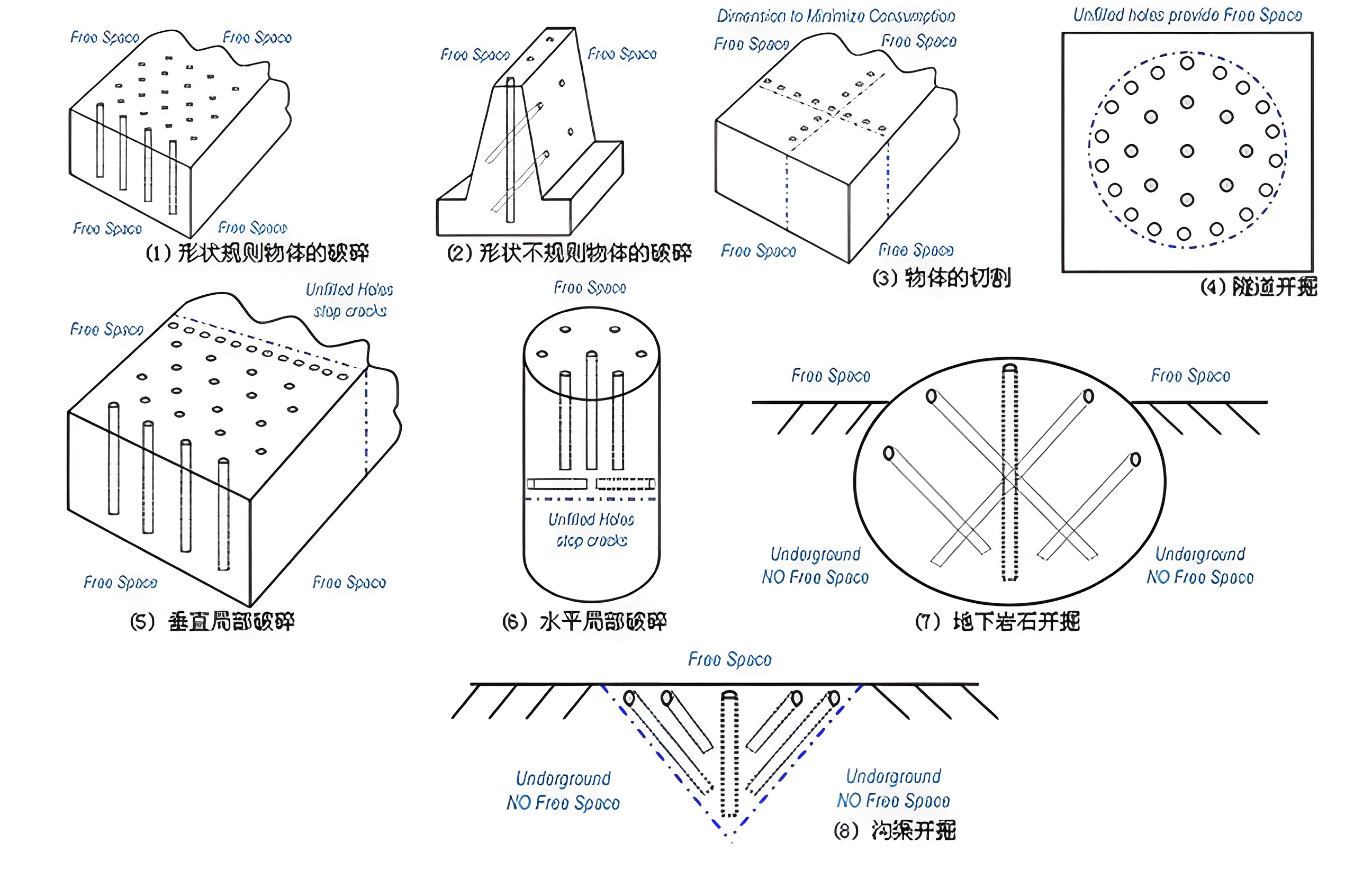
Visual Guide: Choosing between Square and Staggered patterns for optimal pressure distribution.
Staggered vs Square Borehole Layout: Which works better?
Field experience indicates that choosing a staggered vs square borehole layout determines the fragmentation size of the rock. A square pattern is easier to mark out and works fine for simple trenching. However, if you're dealing with very hard rock, a staggered pattern (zigzag) is superior—it leaves no "dead zones" and ensures the expansion pressure hits the rock from multiple angles, leading to cleaner breaks.
Avoid Material Waste
Don't guess how much chemical you need. Once you have your layout ready, use our professional Soundless Cracking Agent (HSCA) Dosage Calculator to get an exact count of bags for your project.
Final Tips from the Field
Hole Depth Matters: Never drill too shallow. We recommend drilling about 1.05 times the height of the rock bench to keep the pressure focused at the base.
Watch the Heat: In high temperatures, the chemical reacts much faster. If you don't match the SCA grade to your local weather, you risk a "blow-out."
Drill Consistency: To keep your borehole layout clean, use a reliable machine like the Expandag RB777 Jack Hammer. Uneven hole diameters lead to irregular cracking.
Expansive Mortar Borehole Layout FAQs
Q1: What happens if my borehole spacing is too wide?
A: If the spacing is too large for the rock hardness, the expansion pressure won't be able to connect the cracks between holes. This results in "isolated holes" where the agent reacts but the rock remains a single solid block, wasting both time and material.
Q2: Why is the staggered pattern preferred for hard granite quarrying?
A: A staggered borehole layout creates a more uniform stress field. In homogenous hard rock like granite, it prevents "dead spots" and ensures the tensile force from one hole overlaps with the next, maximizing the breaking efficiency.
Q3: How do I design a layout for reinforced concrete demolition?
A: Reinforced concrete has higher tensile strength due to the steel mesh. You must reduce the hole spacing (typically 15cm-30cm) and increase the hole diameter to at least 38mm to provide enough expansive force to fracture the concrete away from the rebar.
Q4: Can a borehole layout be designed for underwater rock breaking?
A: Yes, but the layout must account for the cooling effect of the water. We recommend tighter hole spacing and using cartridge-packaged expansive mortar to prevent dilution before the reaction reaches its peak pressure.
Q5: What is the risk of having a "free face" too far from the first row of holes?
A: The "Burden" (distance from the free face) should always be smaller than the hole spacing. If the burden is too large, the pressure will be trapped inside the rock mass with nowhere to go, often leading to a dangerous "blow-out" or steam eruption.
Q6: Should I adjust my drilling pattern based on the ambient temperature?
A: While the physical layout (spacing/diameter) usually stays the same, the timing does not. In extremely cold weather, you may need to reduce spacing by 10% to help the slower chemical reaction overcome the rock's tensile strength more effectively.
Need a Site-Specific Drilling Map?
Contact Expandag engineers today for a customized borehole layout design and professional project consultation.